A China plus one sheet metal supplier in India can reduce your total landed cost by 15–30% on medium-batch custom parts compared to coastal Chinese fabricators — while cutting transit time to US East Coast ports by 4–6 days via the Indian Ocean route. Yet most procurement teams exploring India for the first time spend months qualifying suppliers they could evaluate in weeks if they understood what to benchmark and where to look.
This guide gives international sourcing managers a structured framework for evaluating Indian sheet metal contract manufacturers: cost structure, equipment verification, quality certifications, export packaging standards, and the logistics advantages that make Chennai one of the most strategically positioned fabrication hubs on the China+1 map.
Why India — and Why Now
Three converging forces are accelerating the shift of sheet metal fabrication orders from China to India:
1. Tariff and Trade Policy Exposure
US Section 301 tariffs on Chinese manufactured goods (currently 25% on most sheet metal components) have fundamentally altered the landed cost equation. European CBAM (Carbon Border Adjustment Mechanism) adds further cost pressure to carbon-intensive Chinese supply chains. Indian exports face neither penalty.
2. Capacity and Capability Maturation
India's precision sheet metal sector has undergone a capital equipment upgrade cycle over the past decade. Tier-1 fabricators now operate:
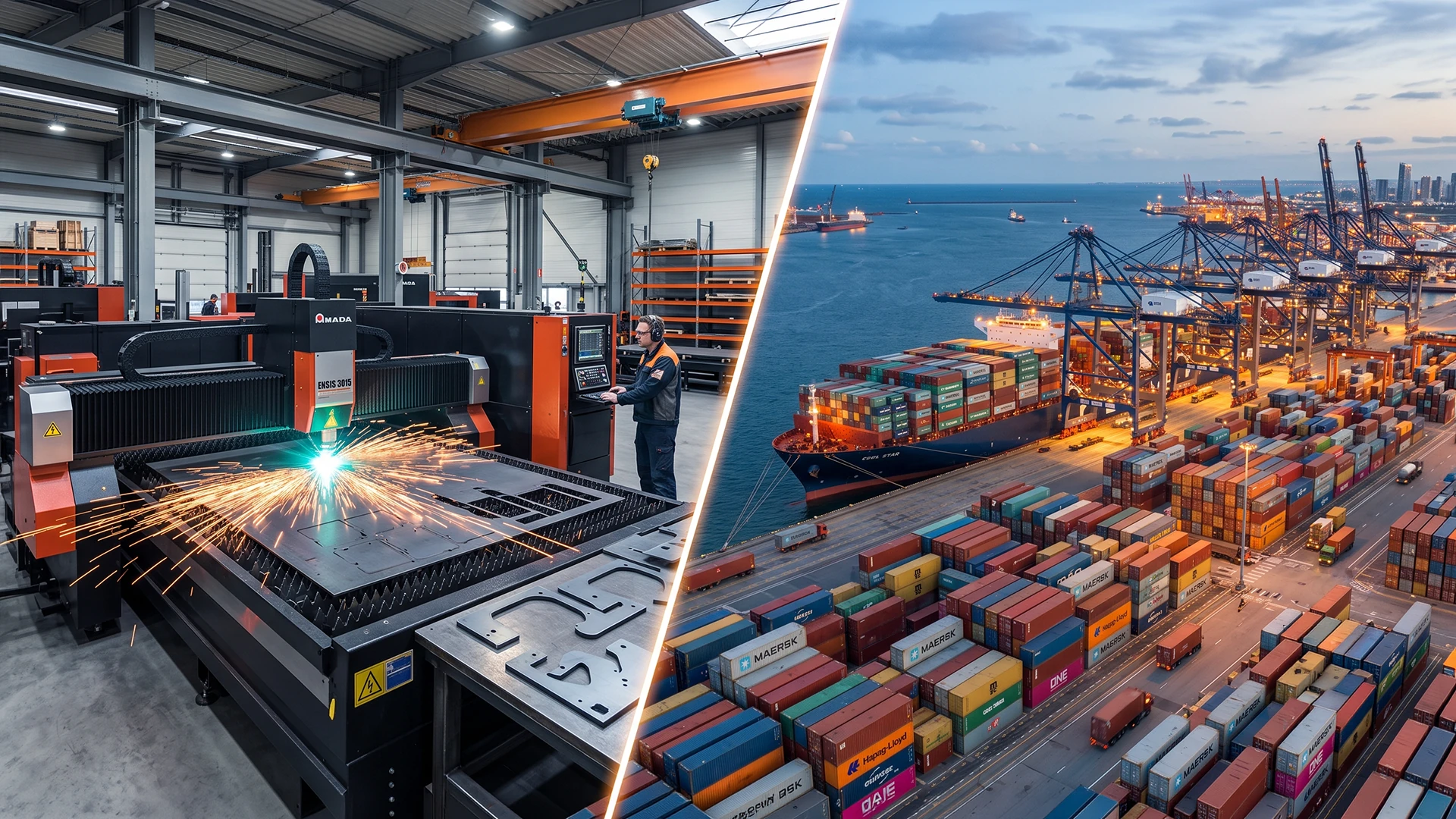
- CNC fiber laser cutting with bed sizes up to 3,000 × 1,500 mm and cutting tolerances of ±0.1 mm
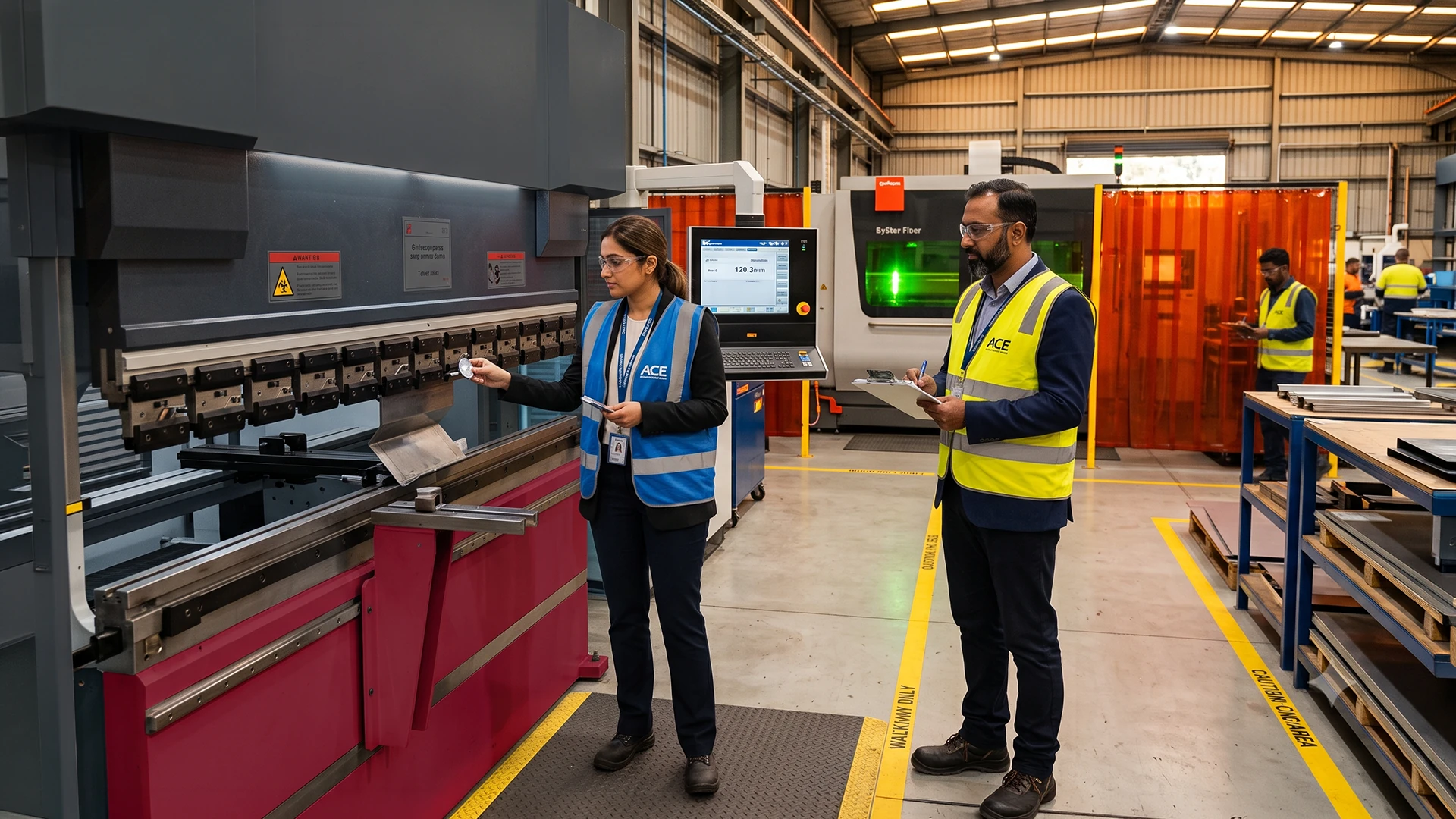
- Multi-axis CNC press brakes (110–200T capacity) with bending angle repeatability within ±0.5°
- Robotic MIG/TIG welding cells certified to AWS D1.1 structural welding standards
- Automated powder coating lines with 7-stage pre-treatment delivering 500+ hour ASTM B117 salt spray performance
3. Port Proximity and Freight Economics
Chennai — India's fourth-largest container port — sits 40 km from the city's industrial belt. A full container load (FCL) from Chennai to the US East Coast transits in 22–28 days via the Suez Canal route, versus 30–35 days from Shanghai. To Rotterdam, transit is 16–20 days.
The 7-Point Supplier Qualification Framework
When evaluating an Indian sheet metal fabrication company as a China+1 partner, assess these seven parameters — the same framework that experienced procurement directors at automotive, electronics, and industrial OEMs apply:
1. Equipment Audit — What Machines Are on the Floor?
- Verify laser wattage and bed dimensions. Fiber lasers (not CO₂) indicate current-generation investment.
- Check press brake tonnage — 110T handles up to 6 mm mild steel across 2,500 mm lengths; 200T covers heavier structural forming.
- Confirm whether welding is manual, semi-automatic, or robotic. Robotic cells deliver consistent weld bead profiles and reduce human-dependent quality variance.
2. Tolerance Verification — What Can They Hold?
- Laser cutting: ±0.1 mm is the benchmark for precision fabricators
- CNC bending: ±0.5° bend angle accuracy
- Weld tolerances per AWS D1.1 for structural steel applications
- Overall assembly tolerances: request CMM (Coordinate Measuring Machine) inspection reports from previous runs
3. Quality Management System
- ISO 9001:2015 certification is baseline
- Ask for weld procedure qualification records (WPQs) and welder qualification test certificates per AWS D1.1 or IS 817
- Verify incoming material test certificates (MTCs) — reputable fabricators cross-check every steel coil against mill certificates
4. Finishing and Surface Treatment
- Multi-stage pre-treatment (degrease → acid etch → zinc phosphate → passivation → DI rinse) is non-negotiable for powder coating adhesion
- Dry Film Thickness (DFT): 60–80 microns for standard industrial applications
- Salt spray performance: 500+ hours per ASTM B117 for corrosion-critical applications
- Cross-hatch adhesion test: ASTM D3359 should pass at 5B rating
5. Material Sourcing Transparency
- Can the supplier trace raw material to the rolling mill?
- Standard materials: CRCA (Cold Rolled Close Annealed), HR (Hot Rolled), HRPO (Hot Rolled Pickled & Oiled), SS 304, SS 316
- Confirm whether the supplier stocks coils in-house or purchases per order — in-house inventory reduces lead times by 5–7 days
6. Export Packaging and Logistics Capability
- ISPM-15 compliant fumigated wooden crating is mandatory for international ocean freight
- Multi-layer VCI (Vapor Corrosion Inhibitor) barrier wrapping for rust-free transit across humid ocean routes
- Container loading plans should be part of the pre-shipment documentation
- Sea-worthy palletization with steel strapping and corner protectors
7. Prototype-to-Production Scalability
- Can the supplier produce 5 prototype units and then scale to 5,000? Evaluate their batch flexibility.
- Request case studies showing progression from prototype approval through multiple production runs with consistent quality
- Confirm their production lead time for repeat orders: 2–3 weeks post-drawing approval is competitive for batch sizes of 50–500 units
Total Landed Cost: India vs. China — A Realistic Comparison
The procurement decision is not about unit price alone. Calculate total landed cost across five categories:
| Cost Component | China (Coastal Tier-1) | India (Chennai Tier-1) | Advantage |
|---|---|---|---|
| Unit fabrication cost (medium batch, 100–500 units) | Baseline | 5–15% lower | India |
| Ocean freight (FCL to US East Coast) | $3,500–5,000 | $2,800–4,200 | India |
| Transit time | 30–35 days | 22–28 days | India |
| Import duty (US) | 25% (Section 301) | 0–3.4% (standard MFN) | India |
| Quality rejection rate (after qualification) | 1–3% | 1–3% | Comparable |
Note: Exact figures vary by component complexity, material, and volume. Request quotations with Incoterms DDP or CIF for accurate comparison.
The tariff differential alone — 25% versus sub-4% — can justify the qualification investment within a single production order.
Common Sourcing Mistakes to Avoid
- Evaluating price without visiting the factory floor. A video call showing CNC machines is not a substitute for verifying machine maintenance logs, tooling condition, and work-in-progress quality at the station level.
- Assuming Indian fabricators cannot hold tight tolerances. Tier-1 Indian facilities with fiber lasers and CNC press brakes match the same ±0.1 mm laser and ±0.5° bend specifications as coastal Chinese peers. The distinction is between Tier-1 and Tier-3 fabricators — not between countries.
- Ignoring export packaging specifications. A perfectly fabricated part that arrives corroded or dented due to inadequate VCI wrapping and container bracing negates every cost advantage.
- Single-sourcing to one country. The point of China+1 is supply chain resilience. Qualifying an Indian partner does not mean abandoning your Chinese supplier — it means having a parallel production-ready alternative for demand surges, tariff shifts, or geopolitical disruptions.
Frequently Asked Questions
1. What is the typical lead time for sheet metal parts from India?
For production batches of 50–500 units, expect 2–3 weeks from drawing approval to dispatch. First-article prototypes typically require an additional 1–2 weeks for tooling setup and dimensional verification.
2. Can Indian fabricators handle multi-process assemblies (cutting + bending + welding + finishing)?
Integrated fabricators with all processes under one roof — laser cutting, CNC bending, robotic welding, and automated powder coating — eliminate inter-vendor tolerance stacking and offer single-source accountability.
3. How do I verify quality remotely before the first shipment?
Request CMM dimensional inspection reports, powder coating DFT readings, weld cross-section photographs, and salt spray test certificates. Reputable fabricators proactively share these with first-article shipments.
4. Is Chennai a good base for sheet metal export manufacturing?
Chennai is India's largest automotive manufacturing cluster and fourth-largest container port, with a mature supplier ecosystem for steel, surface treatment chemicals, and freight forwarding. Its port is 40 km from the industrial zone — minimizing last-mile logistics costs.
Start Your India Qualification Process
Sameta Metal Pro operates a 60,000 sq. ft. integrated fabrication facility in Chennai with CNC fiber laser cutting, multi-axis press brakes, robotic welding, and automated powder coating — all under one roof. We serve OEMs across the US, Europe, and Middle East with ISO 9001:2015 certified production, ISPM-15 export crating, and full traceability from raw material mill certificate to container loading.