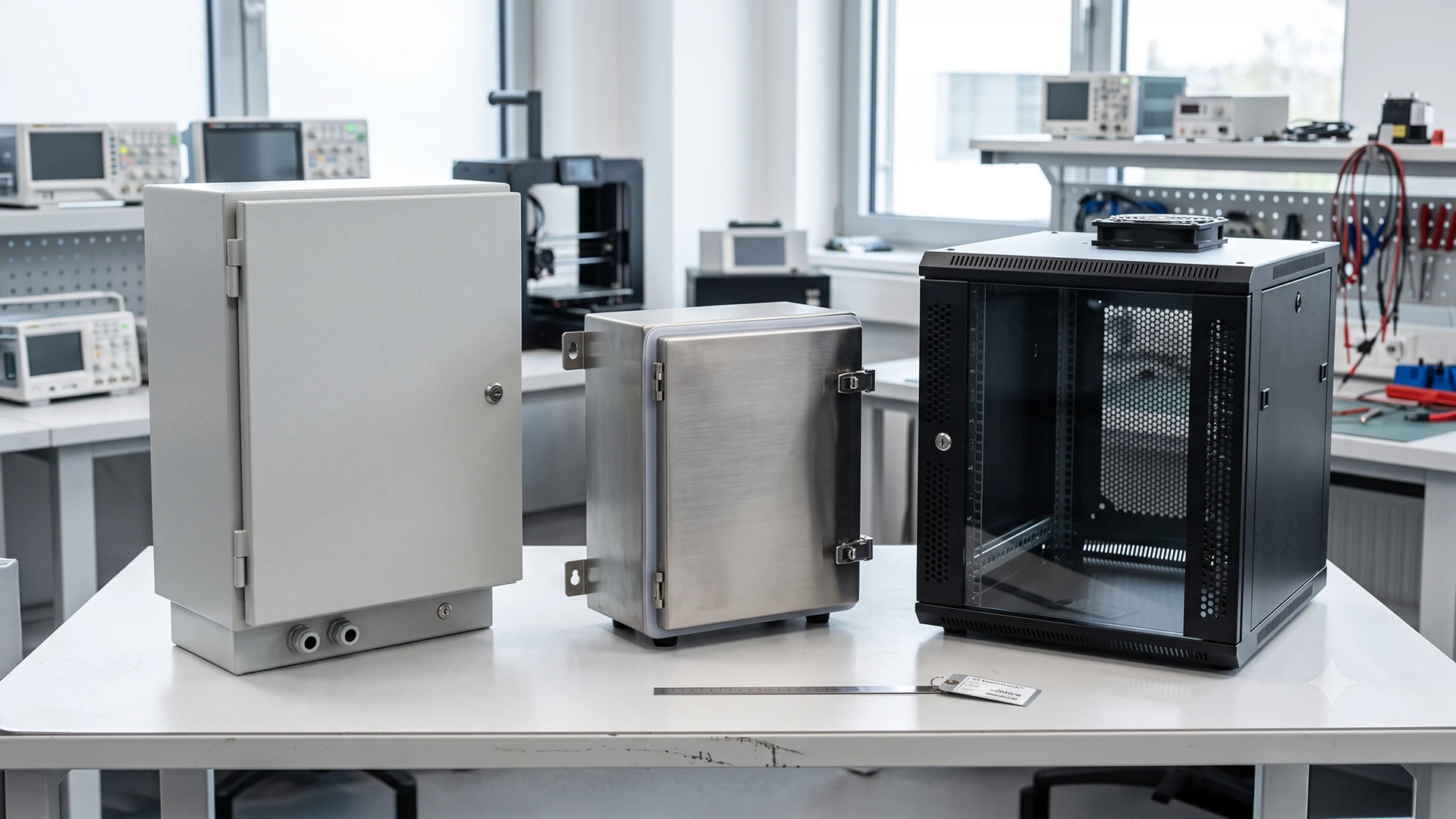
Specifying a custom sheet metal enclosure requires answering three engineering questions simultaneously: what environmental threats must the enclosure block (water, dust, chemicals, electromagnetic interference), what material survives those threats for the required service life, and how does the internal heat load exit without compromising ingress protection. Getting any one of these wrong results in premature component failure, warranty claims, or field recalls that cost orders of magnitude more than the enclosure itself.
This guide provides the decision framework for engineers and procurement teams specifying custom metal enclosures — covering the IP/NEMA rating system, material selection for different environments, thermal management strategies, and the fabrication considerations that affect lead time and cost.
IP and NEMA Rating Decoder: What You Actually Need
The IP (Ingress Protection) rating is a two-digit code defined by IEC 60529. The first digit rates solid particle protection (0–6); the second rates liquid protection (0–9K). NEMA ratings are a US-standard system that overlaps with but does not directly map to IP ratings.
Most Commonly Specified Ratings for Sheet Metal Enclosures:
| Rating | First Digit (Solids) | Second Digit (Liquids) | Typical Application |
|---|---|---|---|
| IP54 | Dust-protected (limited ingress, non-harmful) | Splash-proof from all directions | Indoor industrial panels, electrical distribution boards |
| IP55 | Dust-protected | Low-pressure water jets from all directions | Semi-outdoor installations, food processing areas |
| IP65 | Dust-tight (no ingress) | Low-pressure water jets from all directions | Outdoor telecom cabinets, rooftop equipment, car wash areas |
| IP66 | Dust-tight | High-pressure water jets from all directions | Marine environments, washdown areas, coastal installations |
| IP67 | Dust-tight | Temporary immersion (1 m depth, 30 min) | Underground junction boxes, flood-prone installations |
NEMA Cross-Reference:
| NEMA Rating | Closest IP Equivalent | Additional NEMA Requirements |
|---|---|---|
| NEMA 1 | IP20 | Indoor use only, protection against incidental contact |
| NEMA 3R | IP24 | Outdoor, rain-tight, sleet-resistant |
| NEMA 4 | IP66 | Watertight, dusttight, external ice formation |
| NEMA 4X | IP66 + corrosion resistance | Same as NEMA 4 plus corrosion resistance (typically requires SS 304/316) |
| NEMA 12 | IP55 | Industrial, drip-tight, dust-tight, no knockouts |
> Key distinction: IP ratings test specific ingress conditions. NEMA ratings test additional factors including corrosion resistance, gasket aging, and external ice loading. An IP66-rated enclosure does not automatically meet NEMA 4X unless corrosion resistance is independently verified.
Material Selection: CRCA vs. Stainless Steel vs. Aluminum
The enclosure material determines corrosion lifespan, weight, EMI shielding effectiveness, and cost. Select based on the installation environment — not the cheapest option:
| Material | Corrosion Resistance | Weight | EMI Shielding | Cost Index | Best For |
|---|---|---|---|---|---|
| CRCA Steel (1.2–2.0 mm gauge) | Moderate (requires powder coating) | Heaviest | Excellent | 1.0× (baseline) | Indoor industrial panels, battery enclosures, server racks |
| Galvanized Steel | Good (zinc sacrifice layer) | Heavy | Excellent | 1.1× | Outdoor distribution boards, utility cabinets |
| SS 304 (1.0–1.5 mm) | Very good | Moderate | Good | 2.5–3.0× | Food processing, pharmaceutical, chemical environments |
| SS 316 (1.0–1.5 mm) | Excellent (molybdenum resists chloride pitting) | Moderate | Good | 3.5–4.0× | Marine, coastal, high-salinity, and high-chloride environments |
| Aluminum 5052 (1.5–2.5 mm) | Good (natural oxide layer) | Lightest | Moderate | 2.0× | Telecom, lightweight portable enclosures, rooftop equipment |
Decision rules:
- Default to CRCA with zinc phosphate pre-treatment and 60–80 micron powder coat for indoor installations — it is the most cost-effective and provides excellent EMI shielding
- Specify SS 304 when the enclosure contacts chemicals, cleaning agents, or operates in food-grade environments requiring washdown
- Specify SS 316 for coastal installations within 5 km of saltwater, marine vessels, and any environment with chloride exposure
- Choose aluminum only when weight is a primary constraint (rooftop, pole-mounted, portable)
Thermal Management: Removing Heat Without Compromising IP Rating
Every component inside an enclosure generates heat. Sealed IP65+ enclosures with no thermal management path can exceed internal temperatures of 60–80°C in direct sunlight — well above the 40–55°C operating limits of most electrical and electronic components.
Thermal management strategies by IP requirement:
| Strategy | Heat Removal Capacity | IP Rating Impact | Best For |
|---|---|---|---|
| Ventilation louvers with filters | Moderate (natural convection) | Downgrades to IP44–IP54 max | Indoor dusty environments (IP54 acceptable) |
| Forced-air filtered fans | High (25–50 CFM per fan) | Downgrades to IP54 max | Indoor high-heat-load panels, server racks |
| Heat exchangers (air-to-air) | Moderate–High | Maintains IP65/66 | Outdoor enclosures where ingress rating is critical |
| Thermoelectric coolers (Peltier) | Low–Moderate (50–300W) | Maintains IP65/66 | Small outdoor telecom enclosures, remote instrument cabinets |
| Enclosure air conditioners | High (500W–5kW+) | Maintains IP65/66 | Large outdoor cabinets with high-density electronics |
| Heatsink bosses (external fins) | Moderate | Maintains IP65/66 | LED driver enclosures, power supply housings |
Gasket and Sealing Specifications
The IP rating of any enclosure is only as good as its gasket. Specify:
- Gasket material: Closed-cell silicone sponge (IP65/66 standard), solid silicone (IP67), or EPDM (cost-effective for IP54/55)
- Compression: Gasket must achieve 25–40% compression when the door is latched — under-compression allows ingress; over-compression causes gasket fatigue and permanent set
- Mounting: Continuous gasket in a machined groove or adhered channel around the entire door perimeter — not segmented strips with butt joints (butt joints leak)
- Cable entry: IP68-rated cable glands (not simple rubber grommets) for all cable penetrations — each gland individually rated and installed with proper torque
EMI/RFI Shielding Considerations
For enclosures housing sensitive electronics, communication equipment, or power conversion systems:
- Material: Steel (CRCA or galvanized) provides superior electromagnetic shielding compared to aluminum due to higher magnetic permeability
- Seam treatment: Continuous welded seams provide better shielding than folded/riveted joints — RF energy leaks through any gap > 1/20th of the wavelength
- Conductive gasket: EMI-rated knitted wire mesh gasket or conductive elastomer at the door-to-frame interface
- Paint/coating consideration: Powder coat is electrically insulating — mask gasket contact surfaces to maintain bare metal-to-metal conductivity for EMI grounding
Frequently Asked Questions
1. What is the difference between IP65 and IP66 enclosures?
IP65 protects against low-pressure water jets from all directions (6.3 mm nozzle at 12.5 L/min). IP66 protects against high-pressure water jets (12.5 mm nozzle at 100 L/min). For outdoor installations exposed to heavy rain, hose-down cleaning, or coastal spray, specify IP66 minimum.
2. Can a powder-coated CRCA enclosure survive outdoors?
Yes, for 5–10 years in non-coastal environments. Specify outdoor-rated polyester powder coat at 80 microns DFT with zinc phosphate pre-treatment. For coastal installations within 5 km of saltwater, switch to SS 316 — CRCA will develop under-film corrosion within 2–3 years regardless of coating quality.
3. How do I calculate the required enclosure size for my electrical components?
Map all components (breakers, contactors, terminals, PLCs) on a panel layout drawing with minimum 25 mm clearance between components and 50 mm clearance from the enclosure walls. Add 20% volume overhead for cable routing, ventilation airflow, and future expansion. Depth must accommodate the deepest component plus door gasket compression plus wiring depth (typically 100–150 mm).
4. What is the lead time for custom sheet metal enclosures?
For custom-designed enclosures requiring new flat patterns and tooling, expect 2–3 weeks from drawing approval for first-article production. Repeat orders of established designs ship in 1–2 weeks. Batch production of 50–500 units typically maintains the 2–3 week timeline.
Get Your Enclosure Engineered, Not Adapted
Sameta fabricates custom sheet metal enclosures in CRCA, SS 304, and SS 316 — laser-cut to ±0.1 mm, CNC-bent, robotically welded, and powder-coated with multi-stage pre-treatment. From IP54 indoor panels to IP66 outdoor telecom cabinets and NEMA 4X marine-grade housings, every enclosure is built to your dimensional specifications, not adapted from a catalog box.