Choosing the wrong sheet metal fabrication company costs more than the parts. It costs you 3–6 months of re-qualification, a production schedule that slips past the market window, and the internal credibility of the procurement team that approved the vendor. The vendor who submits the lowest per-unit quote is not automatically the right partner — the right partner is the one whose equipment, quality systems, and capacity match your production requirements at a sustainable cost.
These 10 questions form the vendor evaluation framework used by experienced procurement directors to separate capable fabrication partners from shops that will miss tolerances, deadlines, or both.
Question 1: What CNC Equipment Is on Your Floor?
This is not a question about brand names. It is a question about capability:
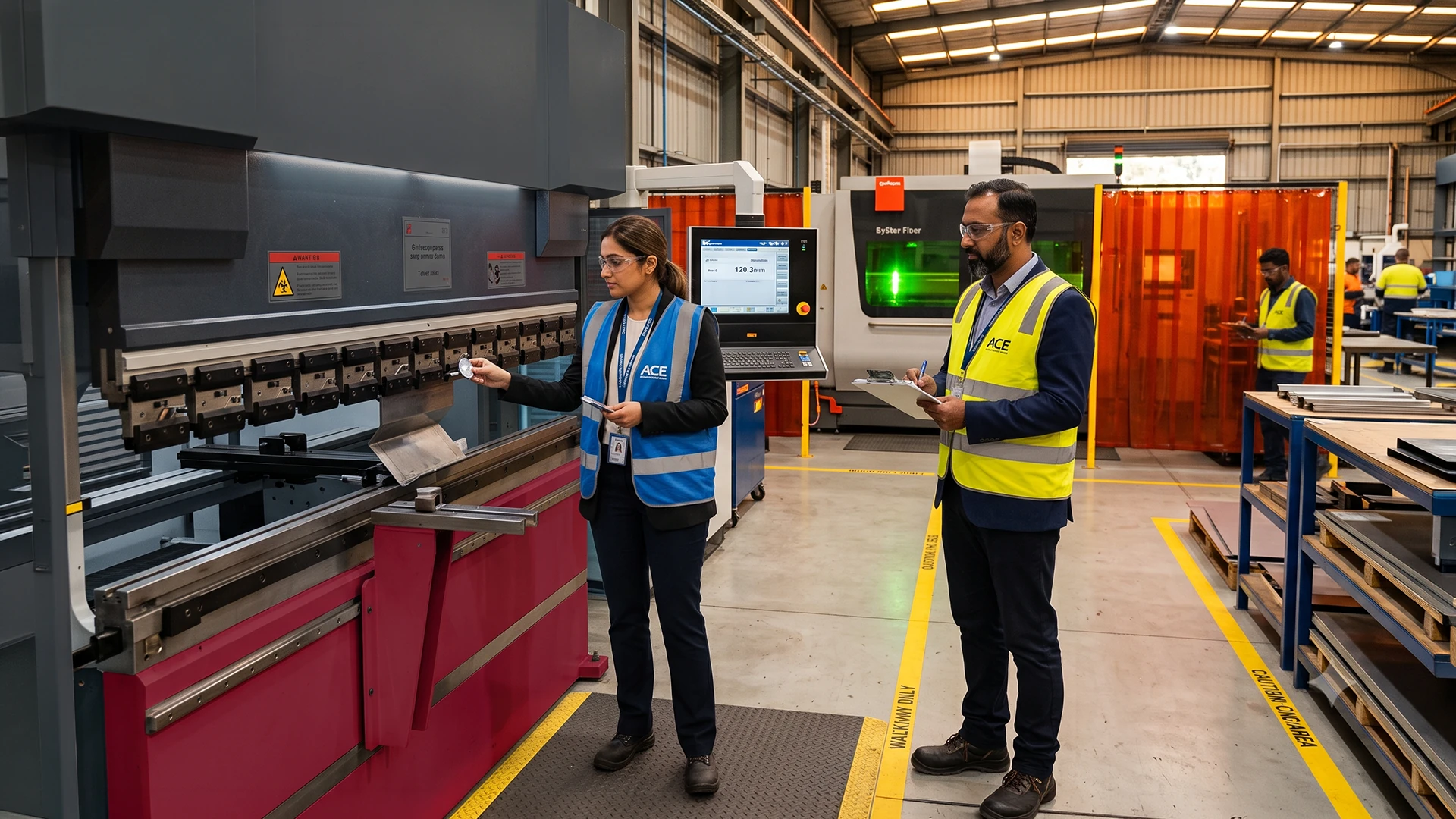
- Laser cutting: Fiber laser (current generation) or CO₂ laser (previous generation)? Fiber lasers cut faster, consume less energy, and handle reflective materials better. What is the bed size (determines maximum sheet dimension)?
- Press brakes: What tonnage range? 110T handles up to 6 mm mild steel across 2,500 mm lengths. 200T covers heavier structural forming. How many axes of CNC control (backgauge positioning)?
- Welding: Manual, semi-automatic, or robotic? Robotic welding eliminates human-dependent quality variance and produces consistent weld bead profiles across production batches.
- Powder coating: Automated electrostatic line or manual spray booth? Automated lines deliver consistent DFT and coverage; manual booths introduce operator variability.
Red flag: A fabricator who cannot give you exact machine specifications (model, year, tonnage, bed size) from memory is either leasing time on someone else's equipment or operating at a scale that does not warrant equipment tracking.
Question 2: What Cutting and Bending Tolerances Can You Hold in Production?
Not on a prototype. Not on the best part from the batch. In sustained production across 500 units.
Benchmark tolerances for a capable fabricator:
- Laser cutting: ±0.1 mm
- CNC press brake bending (angle): ±0.5°
- CNC press brake bending (position): ±0.2 mm
- Robotic welding dimensional conformance: ±0.5 mm
Ask for Cpk data (process capability index) on critical dimensions from a recent production run — not just a spec sheet claim. A Cpk ≥ 1.33 confirms the process is centered and capable.
Question 3: What Quality Certifications Do You Hold?
Baseline: ISO 9001:2015 — this is table stakes. A fabricator without ISO 9001 lacks documented quality management procedures.
Elevated requirements:
- AWS D1.1 certification for structural steel welding — required for any load-bearing assembly
- Welder Qualification Test Records per AWS D1.1 or IS 817 — verify that the individuals operating the welding stations are certified, not just the facility
- ISO 14001 (Environmental Management) — relevant for clients with ESG reporting requirements
Question 4: What Is Your Incoming Material Verification Process?
A fabricator who does not verify incoming raw material is building on an unverified foundation:
- Do they require Material Test Certificates (MTCs) from the steel supplier for every coil?
- Do they cross-check chemical composition and mechanical properties against the MTC?
- Do they verify material gauge with digital micrometers before release to production?
Why it matters: A batch of 500 parts fabricated from out-of-spec material thickness (e.g., 1.4 mm instead of specified 1.5 mm) will pass all dimensional checks but fail under load — a hidden quality failure that surfaces in the field.
Question 5: Walk Me Through Your Pre-Treatment and Coating Process
Coating adhesion failures are the #1 warranty claim category in finished sheet metal products. Ask for the specific pre-treatment sequence:
What you should hear:
- Alkaline degreasing
- Water rinse
- Acid etch / pickle
- Zinc phosphate conversion coating
- Passivation (chromate or non-chrome sealer)
- DI water final rinse
- Dry-off oven
What should concern you: "We clean the parts and then paint them" — with no mention of chemical conversion coating. Without zinc phosphate, powder coat adhesion relies on mechanical bonding alone, and salt spray performance drops from 500+ hours to under 200 hours.
Question 6: What Is Your Production Capacity and Current Utilization?
- Facility size: Measured in square feet/meters of production floor — not including offices, parking, or undeveloped land
- Shift pattern: Single shift, double shift, or triple shift? A single-shift facility at 85% utilization has no surge capacity for your urgent orders.
- Monthly throughput: Measured in tons of processed steel or units shipped — whichever metric the fabricator tracks
- Current utilization: A facility running at 95%+ utilization will struggle to accommodate your order without impacting other clients' schedules
Ideal partner profile: 60,000+ sq. ft. facility running 2 shifts at 65–75% utilization — enough capacity for your production demands with headroom for volume ramps and priority orders.
Question 7: Can You Handle Prototype Through Volume Production?
Many shops excel at one end of the spectrum but not both:
- Prototype shops produce excellent one-off parts but lack the fixture discipline, batch tracking, and quality systems to maintain consistency at volume
- Volume shops optimize for throughput but cannot economically produce 5-unit prototype runs
The ideal fabrication partner should demonstrate documented case studies showing progression from prototype approval through first-article inspection to repeated production batches with stable quality.
Question 8: What Is Your Inspection and Documentation Standard?
For every production batch, you should receive:
- First Article Inspection Report (FAIR) with dimensional data on every critical feature
- Powder coating DFT report with readings at specified measurement points
- Photographic records of weld quality at critical joint locations
- Material traceability linking finished parts to incoming material MTCs
A fabricator who resists providing documentation is either not generating it (no quality system) or not confident in their output.
Question 9: Do You Manage the Full Process Chain Under One Roof?
The more handoffs between separate facilities, the higher the risk:
| Structure | Risk Level | Why |
|---|---|---|
| All processes in-house (cut, bend, weld, coat) | Lowest | Single-source accountability, no inter-vendor tolerance stacking |
| Core processes in-house, coating outsourced | Moderate | Coating vendor schedule and quality outside direct control |
| Multiple subcontractors (cut here, bend there, coat elsewhere) | Highest | Tolerance stacking, finger-pointing, and schedule dependencies on 3+ vendors |
Question to ask: "What percentage of my order's process chain is completed within your four walls?" An answer below 80% warrants deeper investigation into subcontractor management.
Question 10: What Are Your Export Packaging and Logistics Capabilities?
This question only applies to international procurement — but it separates exporters from fabricators who merely sell parts:
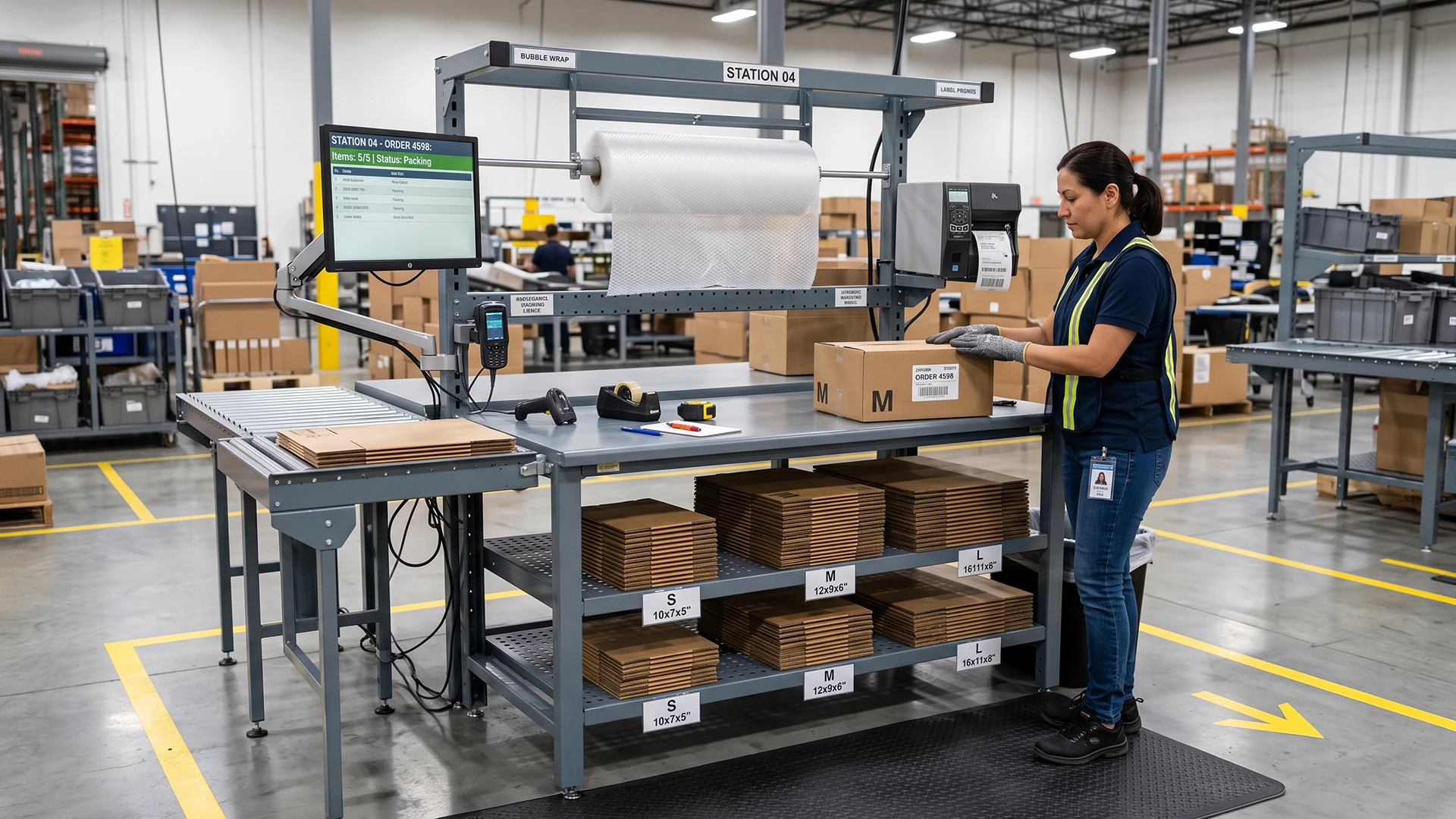
- ISPM-15 fumigated wooden crating — mandatory for international ocean freight
- VCI (Vapor Corrosion Inhibitor) barrier wrap — multi-layer protection against humidity during 3–5 week ocean transit
- Container loading plans — documented packing configurations that maximize container fill and prevent transit damage
- Incoterms capability: Can the fabricator quote FOB, CIF, or DDP? A fabricator limited to Ex-Works may lack freight forwarding experience.
The Scoring Framework
Use this 10-question evaluation with weighted scoring to compare fabrication partners objectively:
| Question | Weight | Scoring |
|---|---|---|
| Q1: Equipment capability | 15% | Score 1–5 based on machine age, technology, and bed size |
| Q2: Production tolerances (with Cpk data) | 15% | Score 1–5 based on achievable vs. required tolerances |
| Q3: Quality certifications | 10% | ISO 9001 = 3; + AWS D1.1 = 4; + environmental = 5 |
| Q4: Material verification | 10% | No MTCs = 1; MTCs filed = 3; MTCs cross-verified = 5 |
| Q5: Pre-treatment and coating | 10% | Manual clean = 1; 3-stage = 3; 7-stage with phosphate = 5 |
| Q6: Capacity and utilization | 10% | Over 90% utilized = 2; 65–75% = 5; under 50% = 3 |
| Q7: Prototype-to-production range | 5% | One end only = 2; documented progression = 5 |
| Q8: Inspection documentation | 10% | No reports = 1; FAIR + DFT + photos = 5 |
| Q9: In-house process chain | 10% | Under 50% in-house = 1; 80%+ = 4; 100% = 5 |
| Q10: Export capability | 5% | Ex-Works only = 2; FOB + VCI + ISPM-15 = 5 |
Frequently Asked Questions
1. How do I evaluate a sheet metal fabrication company remotely?
Request machine specifications with serial numbers, ISO certificates with registrar details, Cpk data from recent production runs, material test certificates, and powder coating salt spray test results. Reputable fabricators provide this documentation proactively — resistance to sharing data is itself a disqualification signal.
2. What certifications should a sheet metal fabricator have?
At minimum, ISO 9001:2015 for quality management. For structural or load-bearing parts, require AWS D1.1 (Structural Welding — Steel) with current welder qualification records. Additional certifications depend on your industry — IATF 16949 for automotive, ISO 13485 for medical devices.
3. How important is it that all fabrication processes are under one roof?
Critical. Each handoff between separate vendors introduces tolerance stacking, schedule risk, and accountability gaps. A part laser-cut at one shop, bent at another, and coated at a third carries cumulative dimensional variance that is impossible to control from the outside.
See the Answers to All 10 Questions, in Person
Sameta Metal Pro operates 60,000 sq. ft. of integrated fabrication in Chennai — CNC fiber laser cutting (±0.1 mm), multi-axis press brakes (up to 200T), robotic welding cells (AWS D1.1), and automated powder coating with 7-stage pre-treatment (500+ hour salt spray). ISO 9001:2015 certified. Full export crating, VCI wrapping, and container loading documentation. Every process under one roof, documented on every shipment.