An optimized warehouse packing table can increase a packer's output from 40 parcels per hour to 55–65 — a 25–40% throughput gain — without hiring additional staff or accelerating work pace. The gain comes entirely from eliminating wasted motion: reducing reach distances, pre-staging packaging materials within arm's length, and positioning scan/print devices at eye level so the packer never breaks their packing rhythm to search, bend, or twist.
This guide provides the ergonomic dimensions, material flow principles, and station layout configurations that industrial engineers and fulfillment operations managers need to design packing stations that maximize parcels per hour (PPH) while minimizing repetitive strain injuries.
The Ergonomic Foundation: Work Surface Height and Reach Zones
Every packing station design begins with the correct work surface height. An incorrect table height causes packers to hunch (too low) or elevate their shoulders (too high) — leading to back and shoulder injuries that account for 34% of warehouse lost-time incidents.
Optimal Work Surface Heights:
| Packer Position | Work Surface Height | Notes |
|---|---|---|
| Standing — light packing | 900–1,050 mm (35–41 in) | Elbow height minus 50 mm; allows forearm-level work without shoulder elevation |
| Standing — heavy items | 750–900 mm (30–35 in) | Lower surface reduces lifting height for items > 10 kg |
| Seated | 650–750 mm (26–30 in) | Requires adjustable-height stool with footrest |
| Height-adjustable (recommended) | 700–1,100 mm range | Electric or crank-actuated adjustment accommodates all packers on rotating shifts |
> Design rule: The packer's elbows should be at or slightly above the table surface when arms hang naturally at the sides. If the packer's shoulders rise during packing, the table is too high. If they hunch forward, it is too low.
The 3 Reach Zones:
- Primary zone (0–300 mm from table edge): Items used in every pack cycle — scanner, tape dispenser, dunnage
- Secondary zone (300–500 mm): Items used frequently — pre-staged carton sizes, label printer output tray
- Tertiary zone (500–900 mm): Items used occasionally — void fill rolls, oversized packaging, manual reference materials
Everything the packer touches in a single pack cycle should be within the primary and secondary zones. Any reach into the tertiary zone signals a station design failure.
The 5-Zone Station Layout
An efficient packing station organizes material flow through 5 sequential zones, arranged left-to-right (or mirrored for left-handed packers):
Zone 1: Inbound Item Staging (Left Side)
- Items arrive from the pick zone via conveyor, cart, or tote handoff
- Inclined gravity roller or shelf positions inbound items at waist height — eliminates bending to retrieve items from floor-level totes
- Capacity: 3–5 orders in queue
Zone 2: Scan and Verify (Left-Center)
- Barcode scanner (fixed or handheld) for order verification
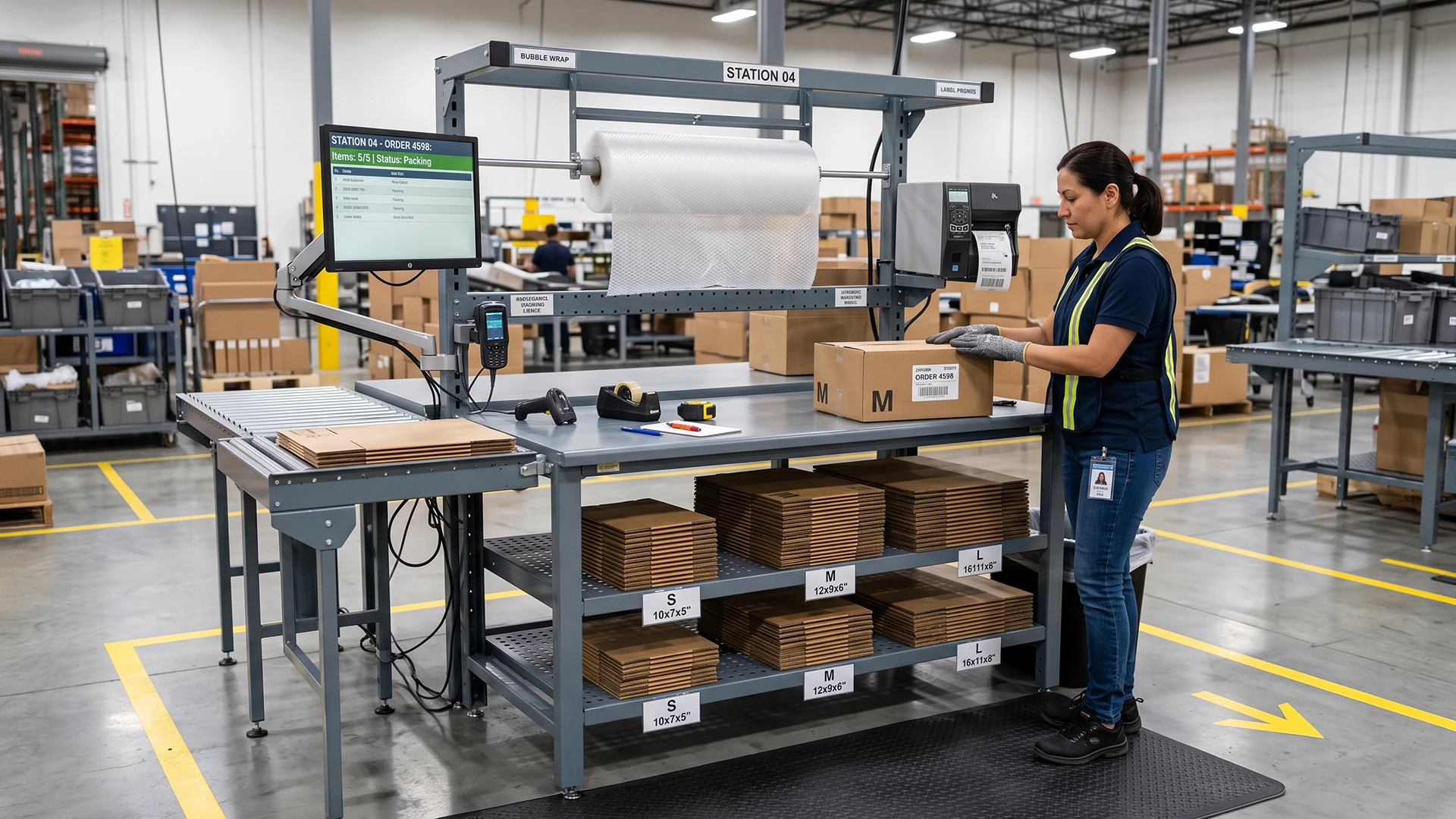
- WMS screen on adjustable monitor arm — positioned at eye level, 400–500 mm from the packer's natural eye position
- Key design: Scanner and screen must be accessible without turning the body — lateral eye movement only
Zone 3: Pack and Protect (Center — Primary Work Surface)
- The main packing table surface — minimum 1,200 × 800 mm (48 × 32 in) clear workspace
- Integrated packing material dispensers mounted above the work surface on an overhead gantry frame:
- Bubble wrap / foam roll dispenser with tear bar
- Kraft paper or air pillow dispenser
- Tape gun holder
- Carton staging: pre-staged flat cartons in 3–4 sizes stored vertically in a slotted holder under the tabletop or beside the station
Zone 4: Label and Seal (Right-Center)
- Thermal label printer at tabletop level — the packer applies the shipping label without walking to a shared printer
- Carton sealing position — the packed and labeled carton exits rightward
- Packing slip / invoice printer (if required) mounted on the gantry frame
Zone 5: Outbound Dispatch (Right Side)
- Gravity roller conveyor or powered belt feeds sealed parcels to the dispatch staging area
- Inclined surface sends parcels away from the station by gravity — no manual push needed
- Reject / QC hold shelf for flagged orders
Structural Specifications for the Packing Table
A warehouse packing table in a high-volume fulfillment center is not office furniture — it is industrial equipment subject to daily impact, static loads, and 16-hour multi-shift operation.
| Component | Specification |
|---|---|
| Frame | Heavy-gauge square tube steel, 40 × 40 mm or 50 × 50 mm, at 2.0 mm wall thickness |
| Work surface | 18 mm laminated MDF on steel substrate, or full steel plate with anti-static rubber mat overlay |
| Load capacity | 200–300 kg UDL (work surface) |
| Overhead gantry | Steel upright posts (30 × 30 mm) bolted to rear of table, supporting dispenser bars and monitor arm mounts |
| Undershelf storage | Perforated steel shelves at 200 mm and 400 mm below work surface — pre-stage cartons and dunnage |
| Leveling feet | Adjustable ±15 mm nylon pads — compensates for uneven warehouse floor slabs |
| Finish | Electrostatic powder coat, 60–80 micron DFT, on all steel components |
| ESD protection (electronics fulfillment) | Conductive tabletop surface with grounding strap connection point |
Throughput Metrics: Before and After Station Optimization
| Metric | Unoptimized Station | Optimized Station | Improvement |
|---|---|---|---|
| Parcels per hour (PPH) | 35–45 | 55–65 | +25–40% |
| Average reach distance | 600–900 mm | 200–400 mm | -50–55% |
| Steps per pack cycle | 3–5 (walking to printer, bending to cartons) | 0 (all materials within arm's reach) | -100% |
| Injury incidents (per 100 FTEs/year) | 8–12 (back, shoulder, wrist) | 3–5 | -55–60% |
Mobile vs. Fixed Stations: When to Choose Each
Fixed stations (bolted to floor, connected to conveyors):
- Best for: Dedicated packing zones with stable daily volume and consistent product mix
- Advantage: Maximum stability, integrated conveyor connections, permanent utility hookups (power, compressed air, network)
Mobile stations (caster-mounted, self-contained):
- Best for: Flexible fulfillment operations with seasonal volume spikes, multi-use warehouse zones, or dynamic floor plans
- Advantage: Redeploy stations to different zones within minutes; nest or store idle stations during off-peak periods
- Specification: 4 heavy-duty swivel casters (125 mm PU, 2 with brakes), total station load including materials ≤ 400 kg
Frequently Asked Questions
1. What is the ideal height for a warehouse packing table?
For standing packers handling lightweight items, the optimal work surface height is 900–1,050 mm — positioned so the packer's elbows are at or slightly above the table surface. Height-adjustable tables (700–1,100 mm range) are recommended for facilities with rotating shifts and varying packer heights.
2. How much space does a packing station need?
A single packing station requires approximately 3.0 × 2.0 m (6 sq. m) of floor area — including the table, inbound staging, outbound conveyor, and packer standing zone. For multi-station layouts, add 1.5 m aisle clearance between adjacent stations.
3. Can a well-designed packing station really increase output by 25–40%?
Yes. The throughput gain comes from eliminating wasted motion — reducing average reach distance from 600–900 mm to 200–400 mm, eliminating walking steps to shared printers, and pre-staging packaging materials within arm's length. No increase in packer speed is required.
4. Should I invest in height-adjustable or fixed-height packing tables?
Height-adjustable tables cost 20–30% more but accommodate all packer heights across rotating shifts and reduce ergonomic injury rates by up to 60%. For operations running 2–3 shifts with different packer teams, the injury reduction alone justifies the investment within 6–12 months.
Build Packing Stations That Match Your Throughput Ambitions
Sameta engineers heavy-duty warehouse packing tables and industrial workstations with welded steel frames, integrated overhead gantry systems for dispenser mounting, undershelf carton staging, and ESD-safe configurations for electronics fulfillment — designed to push parcels-per-hour performance without pushing your packers past ergonomic limits.