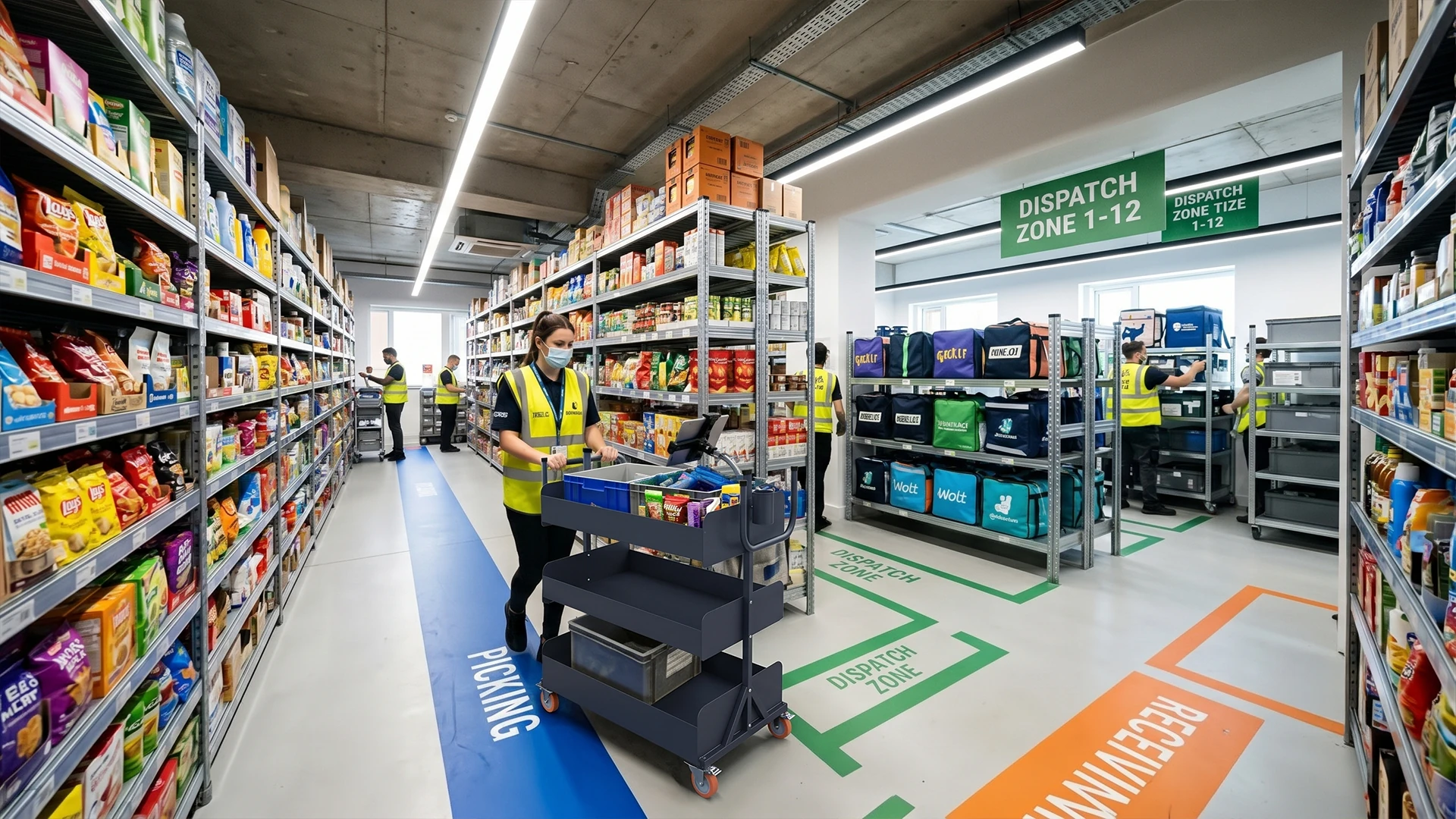
A dark store picking trolley has exactly 90 seconds to travel from the staging zone, through 3–4 aisles, collect 12–15 SKUs across ambient, chilled, and frozen categories, and return to the dispatch counter. Multiply that cycle by 300–400 picks per hour across a 1,200–2,000 sq. ft. micro-fulfillment center, and the equipment on your floor — not just your WMS software — becomes the bottleneck that determines whether you hit your 10-minute delivery promise or miss it.
This guide provides the equipment specification framework, floor layout principles, and fleet sizing methodology for dark store operations teams planning new store launches or optimizing existing locations.
The 4 Equipment Categories Every Dark Store Needs
Category 1: Narrow-Aisle Picking Carts
The picking cart is the single most critical equipment item. It must navigate aisles as narrow as 800 mm, carry multi-order batch picks, and be light enough for pickers to push at walking pace for 6–8 hour shifts without fatigue.
| Specification | Performance Benchmark |
|---|---|
| Chassis width | 480–600 mm (sub-600 mm is mandatory for 800 mm aisles) |
| Turning radius | Zero-radius or center-pivot — must execute U-turns without reversing |
| Tote capacity | 4–8 standard Euro totes (400 × 300 mm or 600 × 400 mm) |
| Load capacity | 80–150 kg UDL |
| Caster config | 4 swivel casters, 100–125 mm PU, with 2 braked for staging hold |
| Weight (empty) | ≤ 15 kg — heavy carts reduce picker velocity and increase shift fatigue |
Cart variants by picking methodology:
- Single-order cart: 1 tote capacity, fastest per-order cycle time — used when average order size ≤ 8 SKUs
- Batch-pick cart: 4–6 tote positions with color-coded dividers — enables simultaneous picking for 4–6 orders in one aisle pass
- Multi-compartment mesh divider cart: Wire dividers create 4–8 variable-size compartments for mixed-size SKUs
Category 2: Delivery Bag Dispatch Stands
After picking, packed orders stage on dispatch stands organized by delivery route or rider assignment. Dispatch stands must support instant visual identification — riders should locate their assigned bag in under 15 seconds.
- Configuration: Multi-tier open-mesh shelving, 4–6 levels, with high-visibility zone number tags
- Capacity: 20–30 delivery bags per stand
- Access: Open-mesh backing allows barcode scanning from both sides — eliminates the need to remove bags for verification
- Footprint: 600 × 400 mm base — stackable against the dispatch wall without obstructing aisle traffic
Category 3: Receiving and Buffer Staging Carts
Inbound inventory arrives in bulk and must be rapidly broken down, sorted by category, and stowed onto shelving. Receiving carts serve as mobile buffer stations between the loading dock and the stow aisles.
- Cart type: Flat-deck platform trolleys (600 × 900 mm deck) or multi-tier shelf trolleys
- Load capacity: 200–300 kg UDL — handles full cases of beverages, canned goods, and bulk FMCG
- Feature: Fold-down side rails convert the shelf trolley into a flat-deck for oversized cartons
- Nestability: Receiving carts should nest 3:1 to 5:1 when idle — dark stores cannot sacrifice floor space to idle equipment
Category 4: Cold Zone Segregation Equipment
Dark stores with chilled and frozen inventory require equipment that operates reliably in cold zones (0°C to -25°C):
- Cold zone picking carts: Nylon casters (not PU — PU becomes brittle below -10°C), stainless steel hardware on cold-zone carts
- Insulated tote holders: Thermal-break cradles that prevent frost condensation from dripping onto ambient products during batch picks that cross temperature zones
- Freezer-door staging shelves: Slimline steel shelving inside the freezer vestibule for pre-staged frozen orders awaiting rider pickup
Dark Store Floor Layout: Zone-Based Equipment Placement
A well-planned dark store divides the footprint into four operational zones, each with purpose-matched equipment:
Zone 1: Receiving Dock (5–10% of floor area)
- Flat-deck receiving trolleys for inbound break-down
- Scanner station for PO verification
- Equipment: 2–3 receiving carts, 1 scanner workstation
Zone 2: Ambient Picking Aisles (50–60% of floor area)
- High-density shelving at 800 mm aisle width
- Picking carts stored at end-of-aisle staging points
- Equipment: 6–10 picking carts (based on peak orders/hour)
Zone 3: Cold/Frozen Zone (15–20% of floor area)
- Dedicated cold-zone carts with nylon casters
- Freezer vestibule staging shelves
- Equipment: 2–4 cold-zone picking carts, 1 freezer staging shelf unit
Zone 4: Dispatch and Rider Staging (15–20% of floor area)
- Delivery bag dispatch stands organized by route/zone
- Rider check-in station with order verification screen
- Equipment: 2–4 dispatch stands (20–30 bags each), 1 packing counter
Fleet Sizing: How Many Carts Does a Dark Store Need?
Fleet sizing depends on two variables: peak orders per hour and average picks per order.
| Dark Store Profile | Peak Orders/Hour | Picking Carts | Dispatch Stands | Receiving Carts |
|---|---|---|---|---|
| Startup (500–1,000 orders/day) | 80–120 | 4–6 | 2 | 2 |
| Growth (1,500–2,500 orders/day) | 150–250 | 8–12 | 3–4 | 3 |
| High-velocity (3,000–5,000 orders/day) | 300–500 | 12–18 | 4–6 | 4–5 |
Rule of thumb: 1 picking cart per 15–20 peak orders per hour when using batch-picking methodology (4 orders per trip). Add 20% fleet buffer for carts in cleaning, repair, or charging rotation.
Equipment Mistakes That Kill SLA Performance
- Using standard warehouse carts in dark store aisles. A 700 mm-wide warehouse trolley cannot navigate 800 mm aisles without constant shelf contact, product displacement, and picker frustration. Purpose-built sub-600 mm chassis carts are non-negotiable.
- Ignoring nesting ratios for idle carts. A dark store operating at 30% capacity during off-peak hours has 70% of its cart fleet idle. Non-nestable carts consume picking aisle space. Specify 4:1 or 5:1 nestable carts that collapse into a 1-meter staging point.
- Installing dispatch stands without route-based organization. Riders searching through 60 randomly placed bags waste 30–60 seconds per pickup. Zone-coded dispatch stands with visible numbering cut rider dwell time to under 15 seconds.
- Deploying PU casters in cold zones. Standard polyurethane casters become hard and brittle below -10°C, losing floor grip and developing flat spots. Nylon casters maintain consistent rolling performance down to -30°C.
Frequently Asked Questions
1. What is a dark store in quick commerce?
A dark store is a retail-format micro-fulfillment center (typically 1,200–3,000 sq. ft.) that is not open to walk-in customers. It exists solely to fulfill online orders for 10–30 minute delivery. Products are arranged for picking speed, not browsing convenience.
2. How narrow should dark store aisles be?
Dark store aisles are typically 800–900 mm clear width — significantly narrower than retail supermarket aisles (1,200–1,500 mm). This maximizes SKU density within the small footprint. Picking carts must have sub-600 mm chassis width to operate in these aisles.
3. How many orders per hour can a single picker handle?
An experienced picker with a 4-order batch cart in a well-organized dark store handles 25–35 orders per hour (100–140 individual SKU picks per hour). This assumes an average order size of 10–12 SKUs and aisle lengths under 15 meters.
4. What equipment should I budget for a new dark store launch?
For a growth-stage dark store (1,500–2,500 orders/day): 8–12 picking carts, 3–4 dispatch stands, 3 receiving carts, 2–4 cold-zone carts, and shelving. Total equipment investment (excluding shelving) typically runs ₹3–6 lakh depending on specifications.
Launch Your Dark Store With Purpose-Built Equipment
Sameta engineers dark store equipment for India's leading quick commerce operators — sub-600 mm picking carts that navigate 800 mm aisles, nestable batch-pick trolleys that collapse 5:1, zone-coded dispatch stands for 15-second rider pickup, and cold-zone nylon-caster carts rated to -25°C. From prototype to 500-unit expansion rollout in 2–3 weeks.