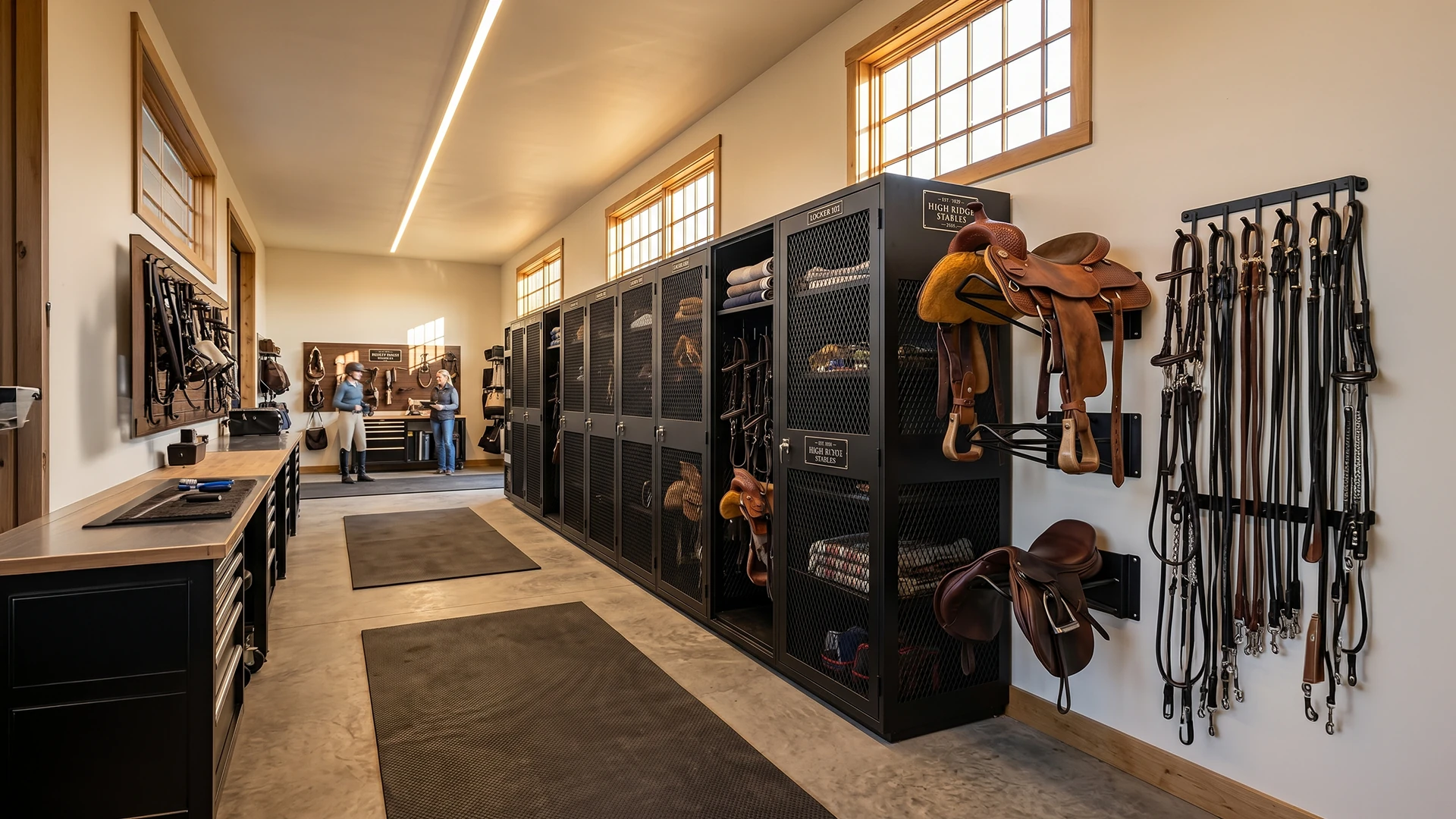
An equestrian tack locker in a commercial barn must protect $2,000–8,000 worth of saddles, bridles, and accessories from the three forces that destroy leather tack: humidity, ammonia, and physical compression. Wood lockers — the traditional choice — absorb barn moisture, harbor mold, warp within 2–3 years, and offer zero resistance to the ammonia vapors that permeate every working stable. Steel tack lockers engineered for equestrian environments eliminate all three failure modes while lasting the 20+ year service life of the barn itself.
This guide provides barn facility managers and equestrian wholesalers with the specification framework for planning commercial-scale tack storage — from locker sizing and ventilation to saddle rack geometry and corrosion-resistant finishing.
Why Wood Fails in Commercial Barn Environments
Traditional wooden tack cabinets have three critical weaknesses in commercial (as opposed to residential) equine facilities:
1. Moisture Absorption and Mold
Horse barns maintain relative humidity of 60–80% year-round. Wood absorbs this moisture, swells, and creates ideal conditions for mold and mildew growth — which transfers directly onto stored leather saddles, breast collars, and bridles.
2. Ammonia Degradation
Horse urine generates ammonia vapors that permeate barn air, even in well-ventilated facilities. Ammonia attacks wood finishes (varnish, stain, paint) within 12–18 months, causing surface degradation and structural softening.
3. Structural Inadequacy Under Heavy Saddle Loads
A Western saddle weighs 25–50 lbs (11–23 kg). A wooden shelf or dowel supporting this weight in a humid, ammonia-rich environment develops sag, split grain, and joint failure — typically within 3–5 years. Commercial barns housing 20–40 saddles cannot tolerate this replacement cycle.
Heavy-Gauge Steel Tack Lockers: The Specification Baseline
Structural Frame:
- Material: Cold-rolled steel tubing, 25 × 25 mm or 30 × 30 mm, at 1.5–2.0 mm wall thickness
- Door panels: Ventilated mesh (expanded metal or welded wire) — provides air circulation while keeping contents secured
- Load rating: Individual locker shelves rated to 50 kg; saddle arms rated to 50 kg (110 lbs) dynamic load per tier
- Locking: Integrated padlock hasp, combination lock provisions, or keyed cam locks for boarding facility security
Interior Layout (Standard Single-Width Locker — 600 mm × 450 mm × 1,800 mm):
| Zone | Height from Floor | Function |
|---|---|---|
| Top shelf | 1,500–1,800 mm | Helmets, grooming kits, lightweight accessories |
| Saddle rack arm | 1,000–1,200 mm | Contoured steel arm for saddle support |
| Bridle hooks | 800–1,000 mm | 3–4 forged steel hooks on back panel |
| Blanket bar / shelf | 400–600 mm | Removable bar or shelf for saddle pads, blankets |
| Boot shelf / floor | 0–400 mm | Tall riding boots, chaps, leg wraps |
Saddle Rack Design: Contoured Geometry That Protects Leather
The saddle rack arm is the most critical component in any equine tack locker — it is the interface between heavy leather goods and the storage system. Incorrect rack geometry damages saddles worth thousands of dollars.
What to specify:
- Tube diameter: 3/4" to 1-1/4" mandrel-bent tubular steel — the large radius distributes saddle weight across the entire gullet channel without creating pressure points
- Contour: The rack arm must follow the natural curve of the saddle gullet — a straight bar creates a pressure ridge that creases and permanently deforms leather
- Finish: Smooth, de-burred, powder-coated surface — any sharp weld seam or burr will mar fine saddle leather
- Clearance: The rack arm extends 300–400 mm from the back wall — sufficient for both English saddles (narrower tree) and Western saddles (wider tree, higher cantle)
Fold-down wall-mount variant: For tack rooms with limited floor space, fold-down saddle racks hinge against the wall when not in use, reducing the rack's projection to under 100 mm. The hinge mechanism must be rated for 50+ kg dynamic load with a positive-locking detent in the open position — preventing accidental collapse when loading a heavy saddle.
Corrosion Protection for Barn Environments
Standard indoor powder coating (60 micron DFT with zinc phosphate pre-treatment) is insufficient for the ammonia-rich, high-humidity, temperature-cycling environment of a working barn.
Barn-grade coating specification:
- Pre-treatment: Full multi-stage chemical conversion (degrease → acid etch → zinc phosphate → passivation → DI rinse)
- Powder coat: Outdoor-rated architectural thermoset polyester powder at 80 microns DFT — provides UV and chemical resistance superior to standard indoor epoxy-polyester blends
- Hardware: Stainless steel hinges, hasp bolts, and fasteners — mild steel hardware will rust within 6 months in barn conditions regardless of coating
- Floor contact: Nylon or HDPE leveling feet — prevents galvanic corrosion between steel legs and damp concrete barn floors
Planning Tack Room Layout for Commercial Barns
| Barn Size | Number of Stalls | Recommended Tack Lockers | Additional Saddle Racks | Floor Area Needed |
|---|---|---|---|---|
| Small boarding facility | 10–15 | 10–15 single-width lockers | 4–6 wall-mount racks | 120–180 sq. ft. |
| Mid-size training barn | 20–30 | 20–30 single-width lockers | 8–12 wall-mount racks | 250–400 sq. ft. |
| Large competition barn | 40–60 | 40–60 lockers (double-row with center aisle) | 15–20 racks + mobile tack caddies | 500–800 sq. ft. |
Layout rules:
- Maintain 1,200 mm minimum aisle width between facing locker rows — allows two people to pass while carrying saddles
- Position saddle wash/cleaning station adjacent to tack room — not inside it — to prevent water and soap residue from contaminating stored tack
- Install ventilation: minimum 4 air changes per hour via exhaust fans or ridge vents — reduces moisture and ammonia concentration
Sourcing Tack Storage from India: The Export Advantage
US and European equestrian distributors sourcing tack lockers from Indian manufacturers benefit from:
- 40–55% cost reduction vs. domestic US/EU fabrication for equivalent heavy-gauge steel construction
- Knockdown (KD) flat-pack shipping — reduces container freight to $2–4 per unit vs. $8–12 for fully assembled lockers
- Private-label OEM capability — custom branding, powder coat colors, and packaging to distributor specifications
- ISPM-15 fumigated export crating with VCI anti-corrosion wrap for rust-free ocean transit
Frequently Asked Questions
1. Are steel tack lockers better than wood for horse barns?
Yes. Steel tack lockers resist barn humidity, ammonia vapors, and heavy saddle loads that cause wood lockers to warp, mold, and fail within 3–5 years. With proper powder coating (80 micron DFT polyester with zinc phosphate pre-treatment), steel lockers last 20+ years in barn environments.
2. How much weight can a steel saddle rack hold?
Heavy-duty tubular steel saddle racks rated for 50 kg (110 lbs) dynamic load support both English and Western saddles without flex or deformation — including heavy Western roping saddles at the top of the weight range (45–50 lbs).
3. What locker size do I need for Western saddles?
Western saddles require a locker with minimum 450 mm internal depth and a rack arm extending 350–400 mm from the back wall to accommodate the wider tree and higher cantle. Standard single-width lockers (600 × 450 × 1,800 mm) accommodate both English and Western saddles.
4. Can I get branded tack lockers manufactured in India for US distribution?
Yes. Indian contract manufacturers offer private-label OEM production with custom powder coat colors, branding, and flat-pack KD shipping in ISPM-15 fumigated export crating. Production lead times are typically 2–3 weeks for batch orders of 50–500 units.
Engineer Your Tack Room, Don't Outgrow It
Sameta manufactures export-grade equestrian tack lockers, fold-down saddle racks, and barn storage hardware in heavy-gauge cold-rolled steel with contoured mandrel-bent saddle arms, outdoor-rated 80-micron powder coating, and stainless steel hardware — built to survive decades of commercial barn service. Private-label OEM production and ISPM-15 flat-pack export crating for US and European distributors.