Every sheet metal fabrication project ends with a finish — and specifying powder coating vs liquid paint incorrectly can mean the difference between a product that survives 500+ hours of salt spray testing and one that blisters within 200. For industrial applications — warehouse racking, retail fixtures, electrical enclosures, export assemblies — the finish is not decorative. It is the corrosion barrier that determines the equipment's operational lifespan.
This guide provides a direct technical comparison between electrostatic powder coating and conventional liquid paint for sheet metal substrates, covering adhesion, durability, environmental compliance, cost, and the application scenarios where each finish is the correct specification.
How Each Process Works
Powder Coating Finely ground thermoset or thermoplastic polymer particles are electrostatically charged and sprayed onto a grounded metal substrate. The charged particles adhere uniformly to all exposed surfaces. The coated part then enters a curing oven at 180–200°C for 10–15 minutes, where the powder melts, flows, and cross-links into a continuous film.
Key process requirements:
- Metal substrate must undergo multi-stage chemical pre-treatment (degrease → acid etch → zinc phosphate conversion → passivation → DI water rinse)
- Part must withstand 180–200°C cure temperature — eliminates plastic, rubber, or heat-sensitive sub-assemblies
- Electrostatic application requires the substrate to be electrically conductive (bare metal)
Liquid Paint Solvent-based or water-based paint is applied via spray gun (HVLP or airless), dip coating, or flow coating. The film forms through solvent evaporation and chemical curing (for 2K polyurethane systems) or air drying (for single-component alkyds).
Key process requirements:
- Multiple coats typically required (primer + topcoat, sometimes primer + basecoat + clearcoat)
- Drying time between coats: 30 minutes to 24 hours depending on chemistry
- VOC (Volatile Organic Compound) emissions require ventilation and regulatory compliance
Head-to-Head Technical Comparison
| Property | Powder Coating | Liquid Paint |
|---|---|---|
| DFT (Dry Film Thickness) | 60–80 microns in a single application | 25–35 microns per coat; 2–3 coats needed for equivalent protection |
| Adhesion (ASTM D3359 cross-hatch) | 5B rating (no flaking on properly pre-treated substrates) | 3B–5B depending on primer quality and surface prep |
| Salt Spray Resistance (ASTM B117) | 500+ hours (with zinc phosphate pre-treatment) | 150–300 hours (2-coat system); 300–500 hours (3-coat system) |
| Impact Resistance (ASTM D2794) | 80–160 in-lb (direct and reverse impact) | 40–80 in-lb |
| UV Resistance | Excellent (polyester powders); Fair (epoxy powders — yellows outdoors) | Good (2K polyurethane); Poor (alkyds — chalking within 1–2 years) |
| Chemical Resistance | Excellent — resists solvents, cleaning agents, mild acids | Good (2K PU); Poor (alkyds — softens with solvents) |
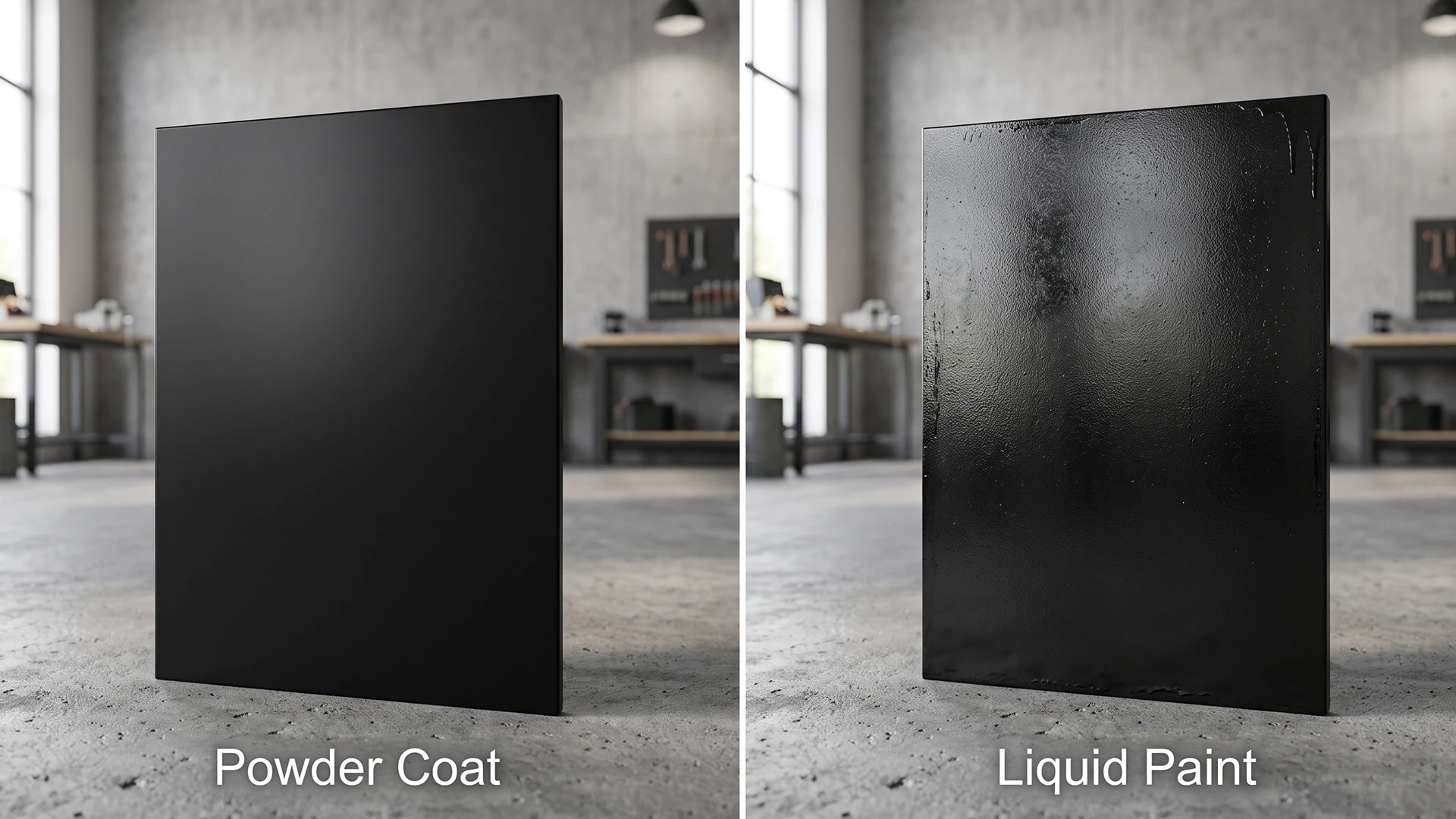
| Surface Finish Quality | Smooth, uniform, no runs or drips — consistent across batch | Operator-dependent — risk of orange peel, runs, sags, and fish-eyes |
| Color Consistency (batch-to-batch) | Excellent — powder is factory-formulated in precise RAL/custom matches | Variable — depends on thinning ratio, spray pattern, operator technique |
| VOC Emissions | Near-zero (no solvents) | 300–600 g/L for solvent-based; 50–150 g/L for waterborne |
| Overspray Reclaim | 95%+ reclaim — overspray collected and reused | 20–50% lost as waste — cannot be reclaimed |
| Cure / Drying Time | 10–15 minutes at 180–200°C | 30 min – 24 hrs per coat (air dry); 30 min at 60–80°C (force dry) |
| Cost per sq. ft. (production volume) | ₹8–15/sq. ft. (single coat, complete) | ₹12–25/sq. ft. (2-coat system with primer) |
When to Specify Powder Coating
Powder coating is the correct specification for the majority of industrial sheet metal applications:
- Warehouse racking and material handling equipment: Subject to forklift impacts, abrasion from pallets, and humid storage environments. Powder coat's impact resistance and single-application 60–80 micron DFT outperforms liquid alternatives.
- Retail store fixtures and gondola shelving: Requires consistent color across 500+ identical units for a store rollout. Powder coating eliminates operator-induced color variation.
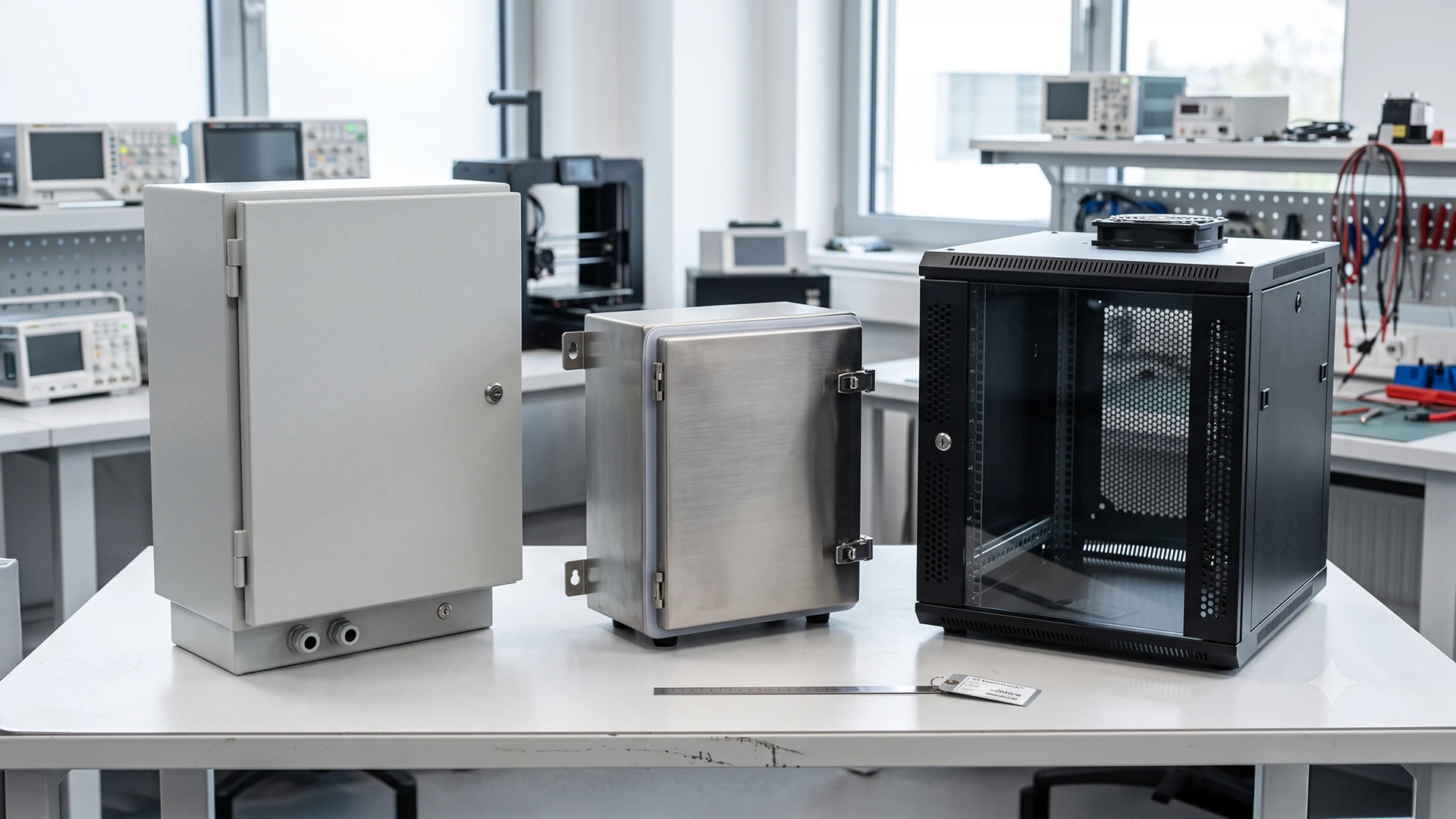
- Electrical and battery enclosures: Needs chemical resistance and consistent dielectric properties. Powder coat provides uniform film thickness critical for insulation performance.
- Export shipments: Ocean freight exposes parts to salt-laden humid conditions for 3–5 weeks. 500+ hour salt spray performance provides the corrosion margin needed for sea transit.
- Any application requiring environmental compliance: Near-zero VOC emissions eliminate solvent handling permits and meet EU RoHS and REACH requirements.
When Liquid Paint Is the Better Choice
Liquid paint remains appropriate for specific use cases:
- Heat-sensitive assemblies: Parts with plastic inserts, rubber gaskets, or electronic components that cannot withstand 180–200°C cure temperatures
- Touch-up and field repair: Powder coating cannot be applied in the field; liquid touch-up paint is the only option for repairing scratches and chips on installed equipment
- Ultra-thin coatings (< 25 microns): Applications requiring very thin conductive coatings — powder coating's minimum practical DFT is approximately 40 microns
- Very large structures: Parts that exceed oven dimensions (powder coating requires full-part oven curing); however, most industrial fabricators operate ovens sized for 3,000 × 1,500 mm sheet dimensions or larger
The Pre-Treatment Process: Where Coating Failures Actually Start
Ninety percent of coating adhesion failures — blistering, flaking, under-film corrosion — are caused by inadequate surface preparation, not the coating material itself.
Industrial-grade pre-treatment sequence:
- Alkaline degreasing — removes mill oils, stamping lubricants, and handling residue
- Water rinse — flushes contaminants
- Acid etch / pickle — removes mill scale and surface oxides, creates micro-roughness for mechanical adhesion
- Zinc phosphate conversion coating — deposits a crystalline phosphate layer (2–5 g/m²) that provides both corrosion resistance and chemical bonding sites for the topcoat
- Passivation (chromate or non-chrome sealer) — seals the phosphate crystal structure against moisture
- DI (deionized) water final rinse — eliminates mineral deposits that cause adhesion defects
- Dry-off oven — drives off residual moisture before coating application
Skipping or shortcutting any stage — particularly the zinc phosphate conversion — reduces salt spray performance by 40–60%.
Frequently Asked Questions
1. Is powder coating more durable than liquid paint?
Yes, for industrial applications. Powder coating delivers 60–80 microns DFT in a single application with 500+ hour ASTM B117 salt spray resistance, compared to 150–300 hours for a typical 2-coat liquid paint system. It also provides superior impact resistance (80–160 in-lb vs. 40–80 in-lb).
2. Can powder coating be applied to any metal?
Powder coating can be applied to any electrically conductive metal substrate that withstands 180–200°C cure temperature — including mild steel, CRCA, stainless steel, aluminum, and galvanized steel. Non-conductive substrates require special primers or flocking application methods.
3. Why is pre-treatment important for powder coating?
Pre-treatment creates the chemical bonding layer between the metal substrate and the powder coat. Without zinc phosphate conversion coating, adhesion relies on mechanical bonding alone, reducing salt spray performance by 40–60% and causing premature blistering in humid or corrosive environments.
4. Is powder coating environmentally friendly?
Powder coating produces near-zero VOC emissions because it contains no solvents. Overspray is 95%+ reclaimable — versus 20–50% waste in liquid paint systems. It eliminates the need for solvent storage permits, vapor extraction systems, and hazardous waste disposal.
Get the Right Finish Specified From Day One
Sameta Metal Pro operates a fully automated electrostatic powder coating line with 7-stage pre-treatment, zinc phosphate conversion, and curing ovens sized for panels up to 3,000 × 1,500 mm. Every batch is verified to 60–80 micron DFT and validated against ASTM B117 salt spray and ASTM D3359 cross-hatch adhesion standards — with test certificates included in shipment documentation.