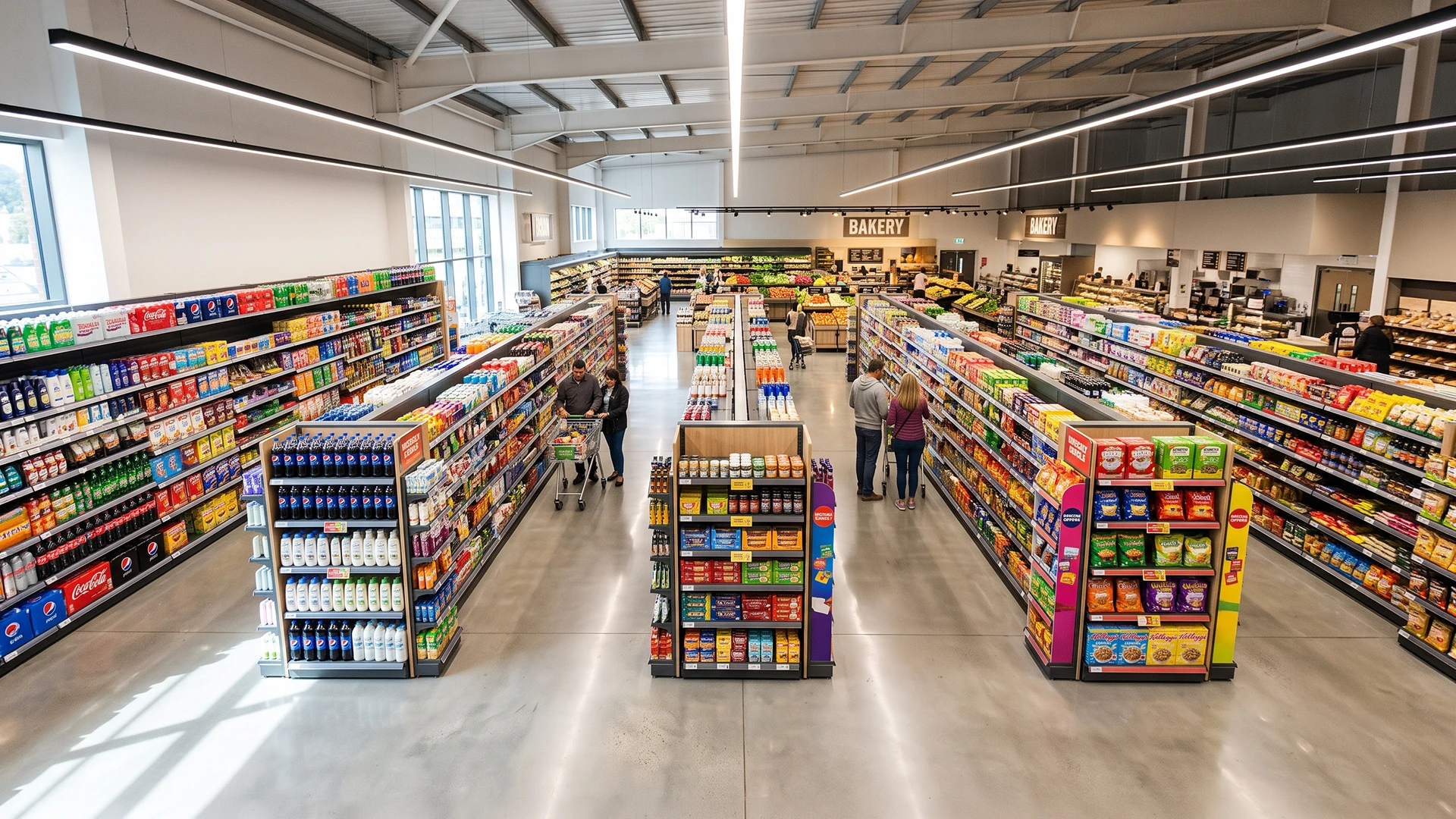
End-cap gondola displays generate 2 to 5 times more sales per linear foot than standard mid-aisle shelving. A four-sided island gondola in a high-traffic intersection captures four-directional foot traffic that wall-mounted units physically cannot reach. Yet the majority of supermarket layouts in India underperform on revenue per square foot because fixture selection and placement follow inherited floor plans rather than data-driven merchandising principles.
This guide provides the structural specifications, layout strategies, and merchandising frameworks that determine how gondola display configurations translate directly into sales density — backed by fixture engineering that withstands the 15–20 year operational life of a modern retail store.
The Three Gondola Configurations Every Supermarket Uses
1. L-Type Wall-Clamped Gondolas (Perimeter Shelving)
Wall gondolas line the store's perimeter walls and are anchored to the wall structure via clamping brackets. They provide single-sided access and are typically the tallest fixtures in the store.
| Specification | Typical Range |
|---|---|
| Height | 1,800 mm – 2,400 mm (floor to top shelf) |
| Depth per shelf | 300 mm – 450 mm |
| Shelf capacity | Up to 120 kg UDL per shelf level |
| Upright pitch | 50 mm perforations for tool-less height adjustment |
| Material | MS CRCA / HRPO with powder coat finish |
Best placement: Fresh categories (dairy, deli, bakery) along the rear wall — forces customers to traverse the full store depth, increasing exposure to mid-aisle impulse zones.
2. T-Type Island Gondolas (Center Aisle — Double-Sided)
Island gondolas are freestanding, double-sided units that form the center aisles. They carry product on both faces and are the primary revenue-generating fixture in any supermarket.
| Specification | Typical Range |
|---|---|
| Height | 1,350 mm – 1,650 mm (lower than wall units for sightline control) |
| Width (back-to-back depth) | 600 mm – 900 mm |
| Shelf capacity | Up to 120 kg UDL per shelf level |
| Bay width | 900 mm – 1,200 mm between uprights |
Critical design principle: Island gondolas must be shorter than wall gondolas by at least 300–500 mm. This height differential creates clear sightlines across the store, allowing customers to orient themselves and see department signage — a proven driver of unplanned purchases.
3. End-Cap Gondolas (Aisle Terminations)
End-caps are the high-conversion promotional zones at the ends of aisles, positioned at perpendicular intersections where customer foot traffic naturally pauses.
- Revenue impact: End-cap placements generate 2–5× more unit sales than the same product shelved mid-aisle
- Usage: Seasonal promotions, new product launches, price-off campaigns, festival bundles
- Rotation cycle: Restock and re-theme end-caps every 2–4 weeks to maintain novelty
5 Gondola Layout Principles That Maximize Sales per Square Foot
Principle 1: The Racetrack (Forced Path) Layout
The most effective supermarket layouts use perimeter wall gondolas to create a "racetrack" perimeter loop, with island gondolas arranged in parallel rows inside the track.
- Customer enters → forced along the produce/fresh perimeter → traverses aisles via island gondolas → exits through checkout
- This layout ensures maximum store coverage — customers walk 70–85% of the total floor area versus 40–50% in free-flow layouts
- Checkout queuing zones should be positioned so that customers face the last aisle of impulse merchandise (confectionery, magazines, beverages)
Principle 2: The Decompression Zone — No Gondolas in the First 3 Meters
The first 3–5 meters inside the store entrance is a "decompression zone" where customers adjust to lighting, temperature, and spatial orientation. Products placed in this zone are chronically underperforming because shoppers are not yet in buying mode.
Use this zone for: Seasonal displays (not gondolas), shopping trolley staging, promotional signage, or fresh flower stands. Place the first gondola after the decompression zone.
Principle 3: Eye-Level Is Buy-Level — Shelf Height Zoning
Within each gondola bay, product placement by shelf height follows well-documented conversion rates:
| Shelf Zone | Height from Floor | Conversion Impact |
|---|---|---|
| Top shelf (stretch zone) | Above 1,600 mm | Lowest conversion; use for lightweight, low-margin bulk items |
| Eye level (bull's-eye zone) | 1,200 mm – 1,500 mm | Highest conversion; reserve for high-margin, promoted, or private-label products |
| Waist level | 800 mm – 1,200 mm | Strong conversion; mainstream brands and large-format packaging |
| Bottom shelf (stoop zone) | Below 800 mm | Low conversion; use for heavy items (cooking oil, bulk rice, beverages) — heavy goods are easier to lift from low positions |
Principle 4: Cross-Merchandising at Aisle Intersections
Place complementary product categories at the intersection of adjacent gondola aisles:
- Pasta shelved adjacent to pasta sauce → cross-category basket uplift of 15–25%
- Breakfast cereal end-cap facing the milk/dairy wall gondola → captures the natural shopper gaze direction
- Baking ingredients aisle terminating at the bakeware/utensil end-cap
Principle 5: The Impulse Triangle — Checkout, End-Cap, and Dump Bin Placement
Position the highest-impulse items within a 3-meter triangle anchored by the checkout counter:
- End-cap gondola at the last aisle before checkout — seasonal promotions, bundled snacks
- Dump bins (3-tier wire basket impulse trolleys) flanking the checkout queue — confectionery, small electronics, single-serve beverages
- Checkout counter impulse shelves — gum, mints, batteries, phone accessories
This triangulated placement catches customers three times in the final 30 seconds of their shopping journey — the window where impulse conversion is highest.
Fixture Engineering That Sustains 15+ Years of Retail Abuse
Retail gondolas endure daily impacts from restocking trolleys, customer cart collisions, and cumulative static loads from 50+ kg of packaged goods per shelf. Consumer-grade fixtures with thin-gauge pressed steel begin to show shelf deflection, paint chipping, and upright buckling within 2–3 years.
What to specify for commercial-grade durability:
- Uprights: CNC-punched with 50 mm pitch perforations — allows tool-less shelf repositioning with standard shelf brackets. Cold-rolled steel minimum 1.5 mm gauge.
- Shelf panels: Heavy-gauge CRCA steel with triple bottom hat-channel stiffeners — eliminates visible sag under 120 kg UDL
- Finish: Multi-stage chemical pre-treatment (degrease, phosphate, passivate) + electrostatic powder coat at 60–80 microns DFT. Specify polyester powder for UV resistance in stores with natural daylight sections.
- Accessories: Slot-in price ticket channels, peg hooks (for hanging merchandise), shelf dividers, and wire basket add-ons — all should attach to the 50 mm pitch slots without tools
Frequently Asked Questions
1. What is the ideal aisle width between island gondolas in a supermarket?
For standard shopping trolley traffic, maintain 1,200 mm – 1,500 mm clear aisle width between facing gondola shelves. Wider aisles (1,800 mm+) are specified for hypermarkets with high-volume trolley traffic and ADA/accessibility compliance. Narrower aisles below 1,000 mm create congestion and reduce dwell time per category.
2. How many gondola bays do I need for a 5,000 sq. ft. supermarket?
A typical 5,000 sq. ft. (465 sq. m) neighborhood supermarket requires approximately 40–60 wall gondola bays (perimeter) and 30–50 island gondola bays (center aisles), plus 8–12 end-cap units. Exact count depends on aisle width, category depth, and checkout counter placement.
3. What is the maximum shelf load capacity for FMCG supermarket gondolas?
Industrial-grade gondolas with heavy-gauge CRCA steel shelves and bottom stiffeners support up to 120 kg Uniformly Distributed Load (UDL) per shelf level — sufficient for packaged rice, cooking oil, canned goods, and bulk FMCG products.
4. Can gondola shelves be adjusted without tools?
Yes. Gondolas with CNC-punched upright columns at 50 mm pitch use slot-in bracket systems that allow shelf height adjustment in seconds without any tools — enabling rapid planogram changes for seasonal resets and promotions.
Plan Your Complete Store Fixture Rollout
From L-type wall gondolas and T-type island fixtures to checkout counters, produce stands, and impulse dump bins, Sameta manufactures the full spectrum of supermarket display fixtures in heavy-duty CRCA steel with food-grade powder coating — engineered for 15+ year commercial lifecycles with tool-less shelf adjustment and 120 kg/shelf load ratings.