A single warehouse roll cage trolley in daily operation travels 8–12 km per shift across dock, aisle, and staging zones. Over a 5-year service life, that is 15,000+ km of floor contact — equivalent to rolling from Chennai to London. Any procurement decision based solely on unit price, without evaluating nesting efficiency, caster quality, structural durability, and return logistics, will cost the operation multiples of the purchase savings in maintenance, replacement, and wasted floor space.
This guide provides the specification framework that warehouse procurement teams and 3PL operations directors need to evaluate roll cage trolleys correctly — covering the five decision variables that determine total cost of ownership.
Collapsible vs. Rigid: The Fundamental Decision
Every roll cage procurement starts with this binary choice. Each configuration serves a distinct operational profile:
Collapsible (Nestable) Roll Cages
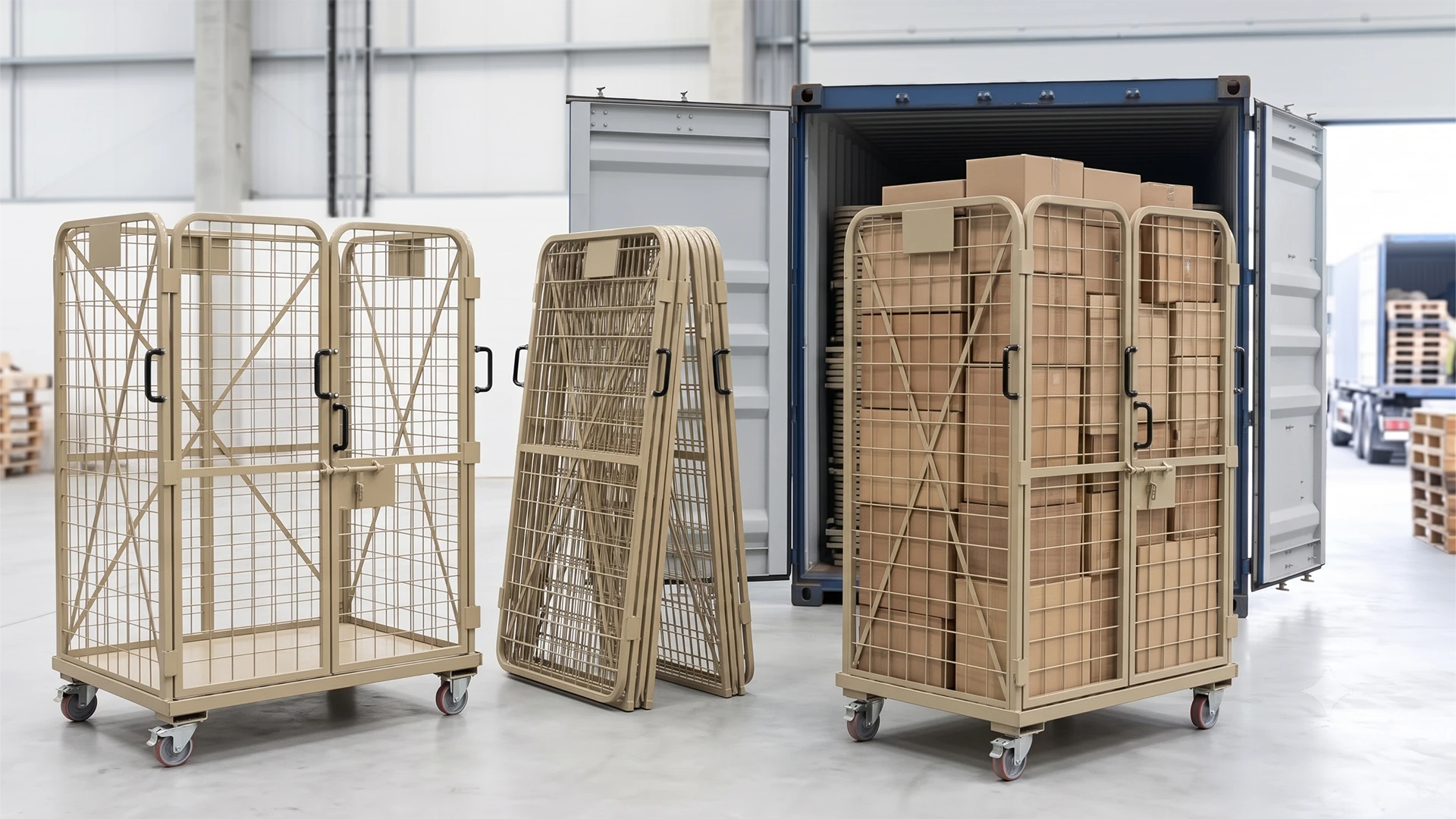
Collapsible roll cages feature hinged side panels and fold-down gates that allow empty units to nest inside each other, reducing storage and return transport volume.
| Specification | Typical Range |
|---|---|
| Load capacity | 500–800 kg UDL |
| Nesting ratio | 4:1 (4 empty cages occupy the space of 1 deployed cage) |
| Deployment time | 10–15 seconds per unit (single operator) |
| Best for | Return logistics, milk-run distribution, multi-site operations |
Rigid (Fixed-Wall) Roll Cages
Rigid roll cages have permanently welded side panels and provide maximum structural integrity. They cannot nest.
| Specification | Typical Range |
|---|---|
| Load capacity | 800–1,000 kg UDL |
| Nesting ratio | 1:1 (no nesting — each empty cage occupies full footprint) |
| Deployment time | Zero (always ready) |
| Best for | Single-site warehouse loops, heavy industrial loads, cold chain |
The 4:1 nesting advantage: A fleet of 200 collapsible roll cages occupies the same return truck footprint as 50 deployed cages. For operations that regularly transport empty cages between facilities — distribution centers, hub-and-spoke delivery networks, retail store replenishment — this nesting ratio reduces empty return freight costs by up to 75%.
5 Specification Variables That Determine Total Cost of Ownership
Variable 1: Load Capacity Rating
Specify load capacity as Uniformly Distributed Load (UDL), not point load. A 500 kg UDL rating means the cage floor supports 500 kg spread across its entire base area. Concentrating the same weight on a single point (e.g., a dense pallet of paint cans in one corner) exceeds the local structural limit.
- 500 kg UDL: Standard for FMCG distribution, retail replenishment, e-commerce parcels
- 800 kg UDL: Heavy distribution — beverages, building materials, automotive parts
- 1,000 kg UDL: Industrial transfer — steel billets, machine components, heavy sub-assemblies
Variable 2: Caster Selection
Casters are the highest-wear component and the primary determinant of rolling resistance, noise, and floor protection.
| Caster Type | Diameter | Load Rating | Best For |
|---|---|---|---|
| Polyurethane (PU) | 125–200 mm (5"–8") | 200–350 kg per caster | Smooth warehouse floors, noise-sensitive environments, clean rooms |
| Nylon | 100–150 mm (4"–6") | 300–500 kg per caster | Heavy loads, rough floors, cold storage (retains hardness at -30°C) |
| Rubber | 150–200 mm (6"–8") | 150–250 kg per caster | Outdoor use, uneven surfaces, dock plate transitions |
Standard configuration: 2 fixed casters + 2 swivel casters with foot-operated brake locks. Fixed casters provide straight-line tracking; swivel casters enable steering. Placing fixed casters at the push end gives the operator directional control.
Variable 3: Construction Material and Gauge
- Mesh panels: Heavy-gauge welded wire mesh (4–5 mm wire diameter, 50 × 50 mm or 50 × 100 mm grid spacing) provides visibility and ventilation while maintaining structural rigidity
- Base platform: 1.5–2.0 mm sheet steel with cross-brace reinforcement stiffeners underneath — prevents sag under heavy UDL
- Frame tubing: 25 × 25 mm or 30 × 30 mm square tube construction at 1.5–2.0 mm wall thickness for corner uprights
Variable 4: Powder Coating and Corrosion Resistance
Roll cages operating in cold storage (0° to -25°C), wet dock environments, or chemical storage zones require coating performance beyond standard indoor protection.
- Standard indoor: 60–80 micron DFT polyester powder coat with zinc phosphate pre-treatment (500+ hour ASTM B117 salt spray)
- Cold chain / outdoor: Hot-dip galvanized base structure with powder coat topcoat — prevents under-film corrosion at condensation-prone joints
- Food-grade / pharmaceutical: Food-safe epoxy powder coat; all welds ground smooth to eliminate bacterial harbor points
Variable 5: Gate and Access Configuration
- Half-gate (drop-down front): Allows forklift loading from the front while retaining side containment — standard for pallet-loaded goods
- Full-gate (swing-open front): Full-height front access for manual loading/unloading of loose parcels and cartons
- No gate (open front): Maximum loading speed for high-velocity sortation — parcels slide directly in
- Double-gate (front + rear): Flow-through access for conveyor-fed loading from one side and manual picking from the other
Common Procurement Mistakes
- Buying on price per unit without calculating return logistics cost. A rigid cage at ₹8,000 that costs ₹200 per empty return trip over 500 trips = ₹1,08,000 total. A nestable cage at ₹11,000 with ₹50 return trips = ₹36,000 total.
- Specifying casters without floor surface assessment. Hard nylon casters on polished epoxy floors cause micro-scratching and noise complaints. Polyurethane casters on rough concrete wear prematurely.
- Ignoring caster replaceability. Bolt-on caster plates allow field replacement without welding or specialized tools. Welded caster mounts require the entire cage to be sent to the workshop when a single caster fails.
- Not testing nesting mechanism under load. Some collapsible designs require the cage to be completely empty before nesting. If your workflow has residual packaging material on the cage floor during nesting, the mechanism jams.
Frequently Asked Questions
1. What is a nestable roll cage trolley?
A nestable (collapsible) roll cage trolley has hinged side panels that fold inward, allowing empty cages to slide inside each other. A 4:1 nesting ratio means 4 collapsed cages fit into the footprint of 1 deployed cage — reducing empty return transport volume by 75%.
2. What is the standard load capacity for a warehouse roll cage?
Standard warehouse roll cages are rated at 500 kg Uniformly Distributed Load (UDL). Heavy-duty variants for industrial and beverage distribution carry 800–1,000 kg UDL. Always verify that the rating is UDL, not point load.
3. What caster type is best for cold storage roll cages?
Nylon casters retain their hardness and load rating at temperatures as low as -30°C, making them the standard choice for cold chain applications. Polyurethane casters can become brittle below -10°C, and rubber casters lose load capacity in freezing conditions.
4. How long should a roll cage trolley last in daily warehouse use?
An industrial-grade roll cage with heavy-gauge steel construction, robotic welds, and 500+ hour powder coating should deliver 5–7 years of daily multi-shift service. Caster replacement every 18–24 months is typical for high-mileage operations.
Specify, Test, and Deploy at Scale
Sameta Metal Pro manufactures collapsible and rigid roll cage trolleys with heavy-gauge welded mesh, 500+ kg UDL base platforms, bolt-on PU/nylon caster modules, and industrial powder coating — engineered for daily warehouse abuse across 15,000+ km of service life. Every design is available for fleet-scale production with 2–3 week lead times from drawing approval.